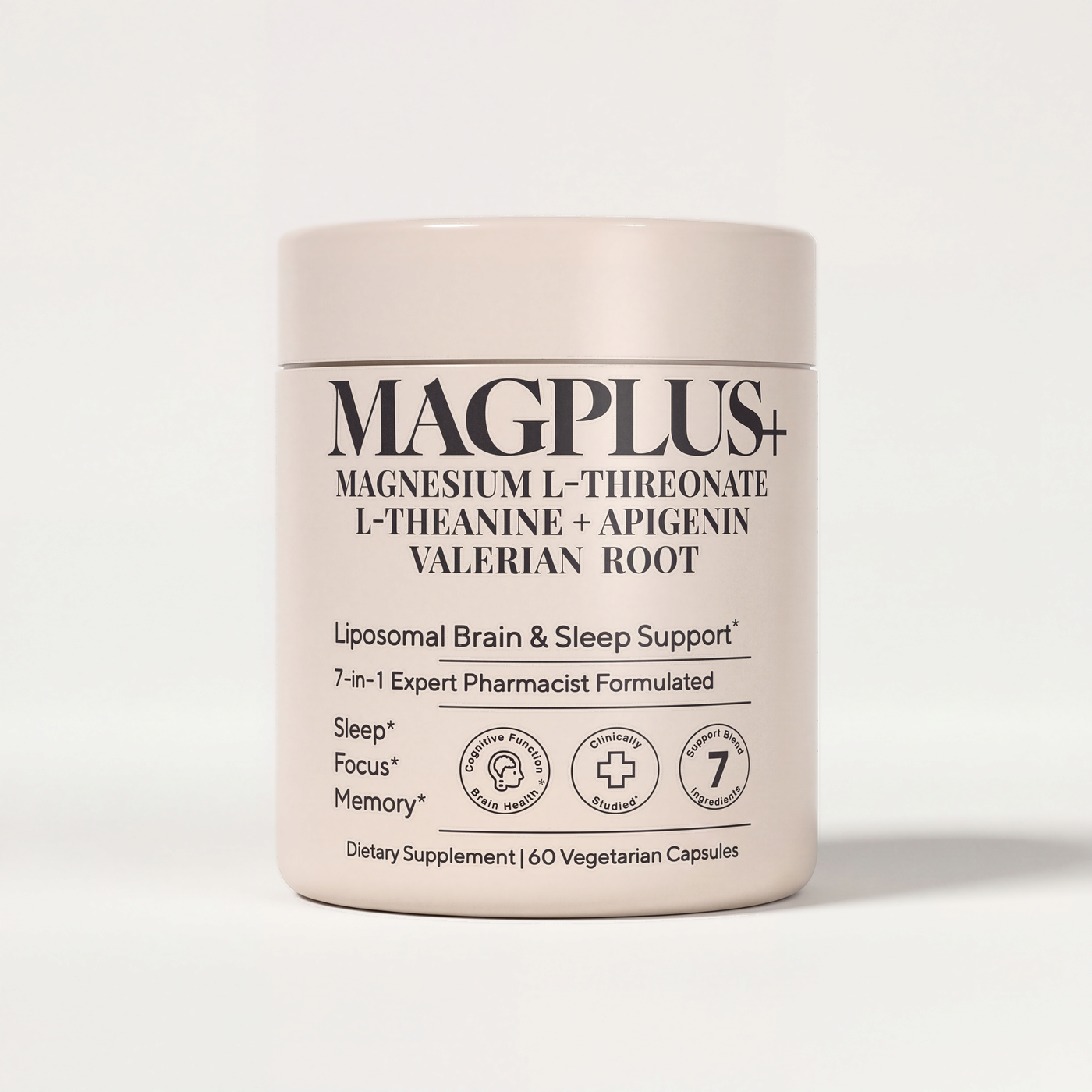
You've probably taken magnesium before. Or heard you should. Or read that most people don't get enough.
All of that is true, and none of it captures what makes MAGPLUS different.
Standard magnesium — magnesium oxide, magnesium citrate, even magnesium glycinate — circulates in the blood and gets taken up by muscles, organs, and cells throughout the body. That's valuable. That's not the problem. The problem is the blood-brain barrier.
The blood-brain barrier is a selectively permeable membrane — one of the most sophisticated biological filters in the body — that controls what gets from circulation into brain tissue. Most things don't cross it. Including most forms of magnesium. Which means that decades of research connecting magnesium to cognitive function, sleep architecture, and brain health were pointing at something most magnesium supplements couldn't meaningfully address.
Then researchers at MIT asked a different question: not how to get more magnesium into the body, but how to get magnesium specifically into the brain.
What MIT Discovered About Magnesium and the Brain
In the early 2000s, Dr. Guosong Liu and colleagues at the Massachusetts Institute of Technology set out to understand why magnesium — a mineral involved in over 300 enzymatic reactions in the body — seemed to have uniquely significant effects on learning and memory when its levels in the brain changed.
Magnesium's role in neurological function is well-documented. It acts as a natural regulator of NMDA receptors — ion channels critical for synaptic plasticity, the process by which neurons strengthen or weaken their connections in response to activity. NMDA receptor function is central to long-term potentiation, the cellular mechanism underlying memory formation. Low brain magnesium correlates with impaired synaptic density and cognitive decline. Aging is associated with declining brain magnesium — in humans and animal models both.
The challenge: how to increase brain magnesium specifically, without requiring doses of standard forms that would cause GI distress or alter blood levels beyond what's clinically appropriate.
The MIT team's solution: magnesium L-threonate. A chelated form of magnesium bound to threonic acid, a vitamin C metabolite, that's transported across the blood-brain barrier via GLUT transporters — the same glucose transporter system the brain uses to pull in energy substrates. Threonate doesn't just carry magnesium. It actively leverages the brain's existing transport infrastructure to deliver it.
The results in preclinical studies were significant enough that the MIT team founded a company — Abiliti (now Magtein) — to develop it as a supplement ingredient. Animal studies showed a 15% increase in brain magnesium levels, a 100% increase in synaptic density in the hippocampus and prefrontal cortex, and measurable improvements in both short-term working memory and long-term memory.
The 2025 Human Clinical Evidence
The most recent and most clinically significant study on magnesium L-threonate was published in Frontiers in Nutrition in 2025. The findings challenged how researchers think about cognitive aging timelines.
In the randomized controlled trial, participants supplementing with magnesium L-threonate over six weeks showed measurable improvements in multiple cognitive domains — executive function, working memory, and attention. The striking finding: brain imaging analysis suggested cognitive age improvements consistent with approximately 7.5 years of reversal on age-related cognitive markers.
Not a 7.5-year improvement in all measures. But a 7.5-year shift on the cognitive biomarkers assessed. In a six-week trial.
The mechanism being studied isn't restoration of youth — it's the repletion of brain magnesium that has been declining, in most adults, since their mid-twenties. When brain magnesium is restored toward optimal levels, the synaptic machinery that depends on it functions more efficiently. Memory consolidation improves. The NMDA receptor activity that underlies learning normalizes.
GRAS status for Magtein was established in the United States market, and the ingredient now has the most substantial human evidence base of any form of magnesium for neurological outcomes specifically.
How MAGPLUS Addresses Sleep (Without Melatonin)
Brain magnesium and sleep quality are inseparable — and the mechanism is more nuanced than most people realize.
Magnesium regulates GABA receptors — the inhibitory neurotransmitter system responsible for calming neural activity. Adequate magnesium supports GABA binding, which helps quiet the brain during the transition from wakefulness to sleep. NMDA receptor regulation by magnesium also matters here: one reason people lie awake with active, racing thoughts is persistent NMDA-mediated neural excitation. Magnesium acts as a physiological brake.
Melatonin — the dominant ingredient in most sleep supplements — does something different and more narrow: it signals the circadian system that it's time to sleep. For people with misaligned circadian rhythms (shift workers, frequent travelers, screen-heavy evenings), that signal is useful. For people whose fundamental problem is that their brain won't quiet down — the hyperactivated neural state that makes falling and staying asleep difficult — melatonin doesn't address the mechanism.
There's also a growing body of evidence suggesting that chronic melatonin supplementation may suppress endogenous melatonin production. The 2025 American Heart Association warning flagged high-dose melatonin as a cardiac risk in susceptible populations. MAGPLUS contains no melatonin — and that's a deliberate formulation choice, not an omission.
The sleep support in MAGPLUS comes from addressing the underlying neuroscience directly.
The Full Formula: Supporting Compounds
L-Theanine (200mg)
L-Theanine is the amino acid responsible for the calm focus associated with green tea — psychoactive effects that occur without caffeine. At 200mg — precisely the dose used in clinical trials — L-Theanine increases alpha brainwave activity, the neural state associated with relaxed alertness and the transition into sleep without grogginess. It works synergistically with magnesium to amplify GABA signaling, reducing sleep onset latency and improving sleep quality in randomized controlled trials.
200mg is the dose the evidence supports. Most L-Theanine supplements deliver 100mg or less. MAGPLUS delivers the clinical dose.
Apigenin (50mg)
The flavonoid responsible for chamomile's anxiolytic effects — but isolated and concentrated. Apigenin is a partial GABA-A receptor agonist, binding the same receptor family as the benzodiazepine drugs but with dramatically lower affinity, no dependency risk, and no next-day sedation. At 50mg, it's the dose used in Dr. Andrew Huberman's widely-cited sleep protocol, supported by the flavonoid binding research.
Apigenin addresses the GABAergic dimension of sleep preparation that L-Theanine and magnesium amplify from different angles.
Chamomile Extract (100mg)
A whole-herb companion to the isolated apigenin — standardized chamomile contains additional flavonoids and terpenoids with mild anxiolytic and anti-inflammatory properties. The botanical matrix provides calming effects that complement the isolated apigenin's receptor-targeted action.
Valerian Root Extract (100mg)
One of the most extensively studied herbal sleep aids in Western botanical medicine. Valerian's mechanisms are multi-pathway: valerenic acid inhibits GABA breakdown (extending GABAergic inhibitory tone), while isovaleric acid interacts with GABA receptors directly. Meta-analyses across multiple trials support improvements in subjective sleep quality and sleep onset. The 100mg dose provides a meaningful contribution in the context of the formula's complete GABAergic and calming architecture.
The Compound Effect: Why Multiple Pathways Matter
Each ingredient in MAGPLUS addresses the neuroscience of sleep and cognitive recovery from a distinct but interconnected angle:
- Magtein repairs the brain magnesium foundation — restoring NMDA and GABA receptor function from the substrate level
- L-Theanine modulates alpha wave activity and GABA signaling acutely, reducing the cortical arousal that keeps people awake
- Apigenin provides direct GABA-A receptor partial agonism — calming neural excitation at the receptor level
- Chamomile and Valerian extend GABA inhibitory tone through enzymatic and receptor pathways
These aren't redundant mechanisms. They're complementary interventions at different points in the same neural pathway — the GABAergic inhibitory system that the brain uses to transition from wakefulness into restoration.
The combined result is a product where each component reinforces the others, and where the absence of melatonin means the circadian system remains self-regulating rather than dependent on an exogenous signal.
What to Expect
MAGPLUS works across two timescales:
Acute effects (night 1 onward): L-Theanine, apigenin, chamomile, and valerian all have relatively rapid onset. Most users report easier sleep onset and a qualitative shift in the depth of sleep — less frequent waking, more consistent rest — within the first week.
Cumulative effects (weeks 3–6+): Brain magnesium repletion is a slower process. Significant changes in brain magnesium levels are measured in weeks of consistent supplementation. Improvements in memory, cognitive clarity, and stress resilience tend to build over this period rather than appearing immediately.
The best metric: subjective sleep quality, next-day cognitive clarity, and exercise recovery — which is markedly impaired by inadequate sleep and brain magnesium depletion.
Who This Is For
Anyone who wants to address sleep and cognitive health at the biological root rather than through a nightly sedative or circadian signaler. MAGPLUS is particularly relevant for:
- People who fall asleep adequately but wake up feeling unrestored
- Those with an active, hyperactivated mind at bedtime
- Anyone concerned about cognitive aging and wants their brain health foundation covered
- People who've stopped taking melatonin due to tolerance concerns or who never found it effective
Pairs best with: The Urolithin A complex — cellular renewal (mitophagy) during sleep combined with the sleep infrastructure that allows that renewal to occur efficiently. Both products operate on the nighttime recovery window from different directions.
Reviewed by the Plus+Ultra Research Team. This article is for educational purposes only and does not constitute medical advice. These statements have not been evaluated by the FDA. This product is not intended to diagnose, treat, cure, or prevent any disease. Consult your physician before beginning any supplementation program, particularly if you take medications affecting the central nervous system.