You've probably never thought of yourself as someone with a nutrient deficiency. You eat reasonably well. You take a multivitamin. You're not dealing with scurvy. But there's a quiet deficiency affecting somewhere between 70 and 80 percent of American adults — one that doesn't show up cleanly on standard blood tests, causes symptoms most doctors chalk up to "stress," and plays a direct role in how well you sleep, how calm your nervous system is, and how functional your body feels day to day. That nutrient is magnesium. And the odds are strong that you're not getting enough of it.

Why Magnesium Deficiency Is So Common
Magnesium is involved in over 300 enzymatic reactions in the body — energy production, muscle contraction, nerve signaling, protein synthesis, blood sugar regulation, and sleep architecture, among others. It is foundational. And yet most people are running low on it, and it's not entirely their fault.
The first problem is the food supply. Soil depletion over the last century has dramatically reduced the magnesium content of crops. The vegetables and grains your grandparents ate had meaningfully more magnesium than what ends up on your plate today. Pile onto that a processed food diet — which is high in refined carbohydrates and low in magnesium-rich whole foods — and the baseline intake for most people is already short.
Then there are the things that actively drain magnesium from your body. Chronic stress triggers cortisol release, and cortisol accelerates urinary magnesium excretion — meaning the more stressed you are, the more magnesium you burn through. Caffeine and alcohol both increase magnesium loss through the kidneys. And several common medications — including proton pump inhibitors (PPIs like Prilosec or Nexium), diuretics, and certain antibiotics — are known to deplete magnesium over time.
The math adds up quickly. You start low, you deplete it daily through stress and coffee and lifestyle, and most people are never actively replenishing it.
The 7 Most Common Signs of Low Magnesium
The tricky thing about magnesium deficiency is that the symptoms are easy to dismiss. They sound like "just being tired" or "just being anxious." Here's what to actually look for.
Muscle cramps and eye twitches. Magnesium is the mineral that tells muscles to relax. Calcium signals contraction; magnesium signals release. When magnesium is low, muscles stay in a state of mild hyperexcitability. This shows up as nighttime leg cramps, eye twitches, or that feeling of general physical tension that never fully resolves.
Trouble falling asleep. Magnesium activates the parasympathetic nervous system — the rest-and-digest state. Without enough of it, the nervous system stays revved. Lying in bed feeling unable to turn your brain off is a classic low-magnesium pattern.
Waking up in the middle of the night. Not just trouble falling asleep — waking at 2, 3, or 4am and struggling to get back down. This is often tied to how magnesium interacts with the body's cortisol rhythm. If 3am wake-ups are your thing, magnesium is one of the first things to look at.
Anxiety or a racing mind. Magnesium plays a key role in regulating the HPA axis — the body's stress response system. Low magnesium is associated with heightened anxiety, irritability, and that low-level sense of dread that's hard to explain. It also supports GABA, the brain's primary inhibitory neurotransmitter. Less magnesium, less GABA activity, more mental noise.
Chronic fatigue that sleep doesn't fix. Magnesium is required for ATP production — the cellular energy currency. If your mitochondria don't have enough magnesium, energy production is inefficient. You can sleep eight hours and still wake up feeling like you haven't.
Frequent headaches or migraines. Research has found lower magnesium levels in people who experience migraines. Magnesium may help support vascular function and neurotransmitter balance, both of which are implicated in headache patterns. Some neurologists recommend magnesium supplementation as a first-line supportive strategy for people with frequent migraines.*
Constipation. Magnesium draws water into the intestines and supports smooth muscle contractions in the gut. Low levels are a well-recognized contributor to sluggish digestion.
If several of those sound familiar at once — that's not a coincidence. These symptoms cluster together because they share an underlying mechanism.

Why Your Blood Test Won't Catch It
Here's where things get frustrating. Many people have asked their doctor about magnesium, gotten a serum magnesium test, and been told their levels look normal. And then continued to experience every symptom on the list above.
The problem is that serum magnesium — the magnesium circulating in your blood — represents only about 1 percent of the total magnesium in your body. The other 99 percent is stored in bones, muscles, and soft tissue. Your body tightly regulates blood magnesium levels, pulling from those tissue stores to keep serum levels stable even when whole-body magnesium is significantly depleted.
This means a normal serum magnesium result does not rule out functional deficiency. It's one of the more poorly understood limitations of standard lab panels. Functional deficiency — where your tissues and nervous system are under-resourced even though your blood looks okay — is entirely possible and quite common.
The more clinically meaningful test is RBC magnesium (red blood cell magnesium), which gives a better picture of intracellular levels. But even that isn't widely ordered. For most people, symptoms and dietary assessment are more useful guides than a standard blood draw.
Why the Form of Magnesium Matters — Especially for the Brain
Not all magnesium supplements are created equal. The form of magnesium determines how well it's absorbed, where it goes in the body, and what it actually does once it gets there.
Magnesium oxide, the most common form in cheap supplements and multivitamins, has poor bioavailability and mostly acts as a laxative. Magnesium citrate is reasonably absorbed but doesn't have strong evidence for brain-level effects. Magnesium glycinate is gentle and well-absorbed, good for general repletion and muscle relaxation.
Magnesium L-Threonate is in a different category. It's one of the only forms studied specifically for its ability to cross the blood-brain barrier and raise magnesium levels in the brain itself — not just in the blood or peripheral tissue. This matters because the brain is where magnesium deficiency shows up as sleep disruption, anxiety, and cognitive fog. Research from MIT found that Magnesium L-Threonate may support synaptic function and sleep-related outcomes.* If you're trying to address sleep quality, a racing mind, or stress-related symptoms, brain magnesium levels are what you actually need to move — and that requires a form of magnesium that can get there.
Putting It Together
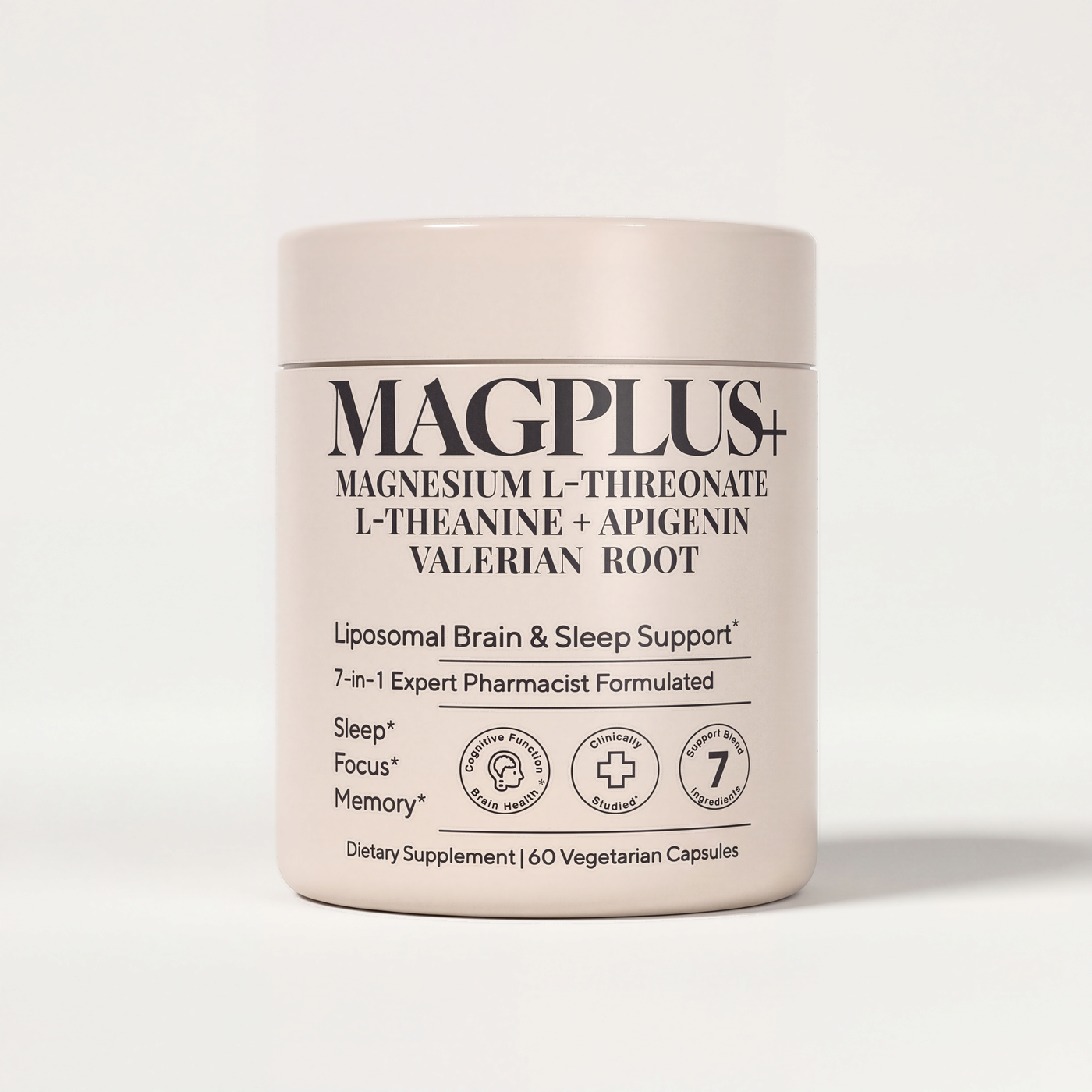
MAGPLUS+ 7-in-1 is our melatonin-free evening formula. Magnesium L-threonate and phosphatidylserine share a 1,050 mg liposomal complex, paired with 200 mg L-theanine, 50 mg apigenin, chamomile and valerian for your wind-down.* Two capsules make one serving.
Choose a supplement around your routine and review the full ingredient list. Persistent sleep problems or symptoms you think could indicate a deficiency are worth discussing with your healthcare provider; symptoms alone do not confirm low magnesium.
If several symptoms on the list above resonated, it may be worth looking more closely at what's actually going on at the mineral level — and whether your current supplement stack is getting magnesium to the parts of your body that need it most.

These statements have not been evaluated by the FDA. This product is not intended to diagnose, treat, cure, or prevent any disease.