Quick Answer: Magnesium glycinate (also called magnesium bisglycinate) is magnesium chelated to the amino acid glycine. The chelation protects it from GI degradation, making it one of the best-absorbed forms. Glycine itself also has independent sleep-supporting properties, giving this form a dual mechanism that makes it particularly well-suited for sleep and nervous system applications.
Magnesium is one of the most studied minerals in human biology — a cofactor in over 300 enzymatic reactions, present in every cell, and involved in everything from ATP production to DNA repair. Yet the way magnesium is packaged into a supplement determines how much of it actually reaches your tissues.
Magnesium glycinate has become the most-recommended form among clinicians and researchers who focus on sleep and neurological health. This guide explains why — and where its strengths end.
1. What Makes Magnesium Glycinate Different From Other Forms
Magnesium doesn't exist in isolation in supplements. It must be bound to something — a carrier molecule — to be stable and bioavailable. That carrier is called the chelate or salt, and it profoundly affects what happens after you swallow the pill.
Common magnesium forms include:
- Magnesium oxide — the cheapest, most common form in low-cost supplements. Poorly absorbed; largely acts as a laxative.
- Magnesium citrate — bound to citric acid; good bioavailability, mild laxative effect at higher doses.
- Magnesium malate — bound to malic acid; preferred for muscle energy and fatigue.
- Magnesium threonate — the only form shown to cross the blood-brain barrier in animal studies.
- Magnesium glycinate / bisglycinate — chelated to glycine; excellent GI tolerance, strong absorption, and a calming amino acid carrier.
Magnesium glycinate is what's called an amino acid chelate. Rather than bonding magnesium to an acid, it bonds magnesium to two glycine molecules (hence "bisglycinate" — bi = two). This structure protects the magnesium ion from interference during digestion.
2. The Bioavailability Advantage: Why Chelation Matters
Bioavailability refers to the fraction of a nutrient that actually enters systemic circulation and reaches the tissues where it's needed. For magnesium, bioavailability is complicated by several factors:
Phytic acid interference. Phytic acid, found naturally in grains, legumes, and seeds, binds to minerals including magnesium in the gut and reduces their absorption. Inorganic forms of magnesium (like magnesium oxide) are more vulnerable to this chelation-in-the-gut problem because their magnesium ion is relatively unprotected.
GI environment degradation. The acidic stomach environment and alkaline small intestine can break apart poorly structured magnesium compounds before they're absorbed. Chelated forms — particularly amino acid chelates — are more stable across this pH range.
Intestinal transporter saturation. Magnesium is absorbed through both passive diffusion and active transport via the TRPM6 and TRPM7 channel proteins. Highly soluble, well-structured forms like bisglycinate interact better with these absorption pathways.
Research comparing magnesium forms has generally found that amino acid chelates demonstrate superior fractional absorption compared to inorganic forms. A study by Siebrecht (2013) in the Journal of the American Nutrition Association found that magnesium bisglycinate showed approximately twice the relative bioavailability of magnesium oxide.
The glycine molecule also appears to facilitate uptake through peptide transporters in the intestinal wall — a secondary absorption route that oxide and citrate forms don't benefit from in the same way.
3. The Glycine Effect: Double Benefit for Sleep
This is what separates magnesium glycinate from most other chelated forms. Glycine isn't just a delivery vehicle for magnesium — it's a bioactive amino acid with its own documented effects on sleep.
Glycine functions as an inhibitory neurotransmitter in the central nervous system. It activates glycine receptors in the brainstem and spinal cord, producing calming, inhibitory signals. It also modulates NMDA (N-methyl-D-aspartate) receptors in the brain, which are involved in arousal and stress responses.
The clinical evidence is direct. Bannai et al. (2012), published in Sleep and Biological Rhythms, conducted a randomized, double-blind, crossover trial giving participants 3 grams of glycine or placebo before bed. The glycine group showed:
- Significantly improved sleep quality scores (as measured by the St. Mary's Hospital Sleep Questionnaire)
- Reduced sleep latency (time to fall asleep)
- Improved morning alertness and daytime cognitive performance
- No next-day grogginess
The mechanism involves glycine's ability to lower core body temperature by promoting peripheral vasodilation — which is one of the body's natural signals that it's time to sleep. Core body temperature naturally drops at sleep onset, and glycine appears to facilitate this process.
When you take magnesium glycinate, you're not just getting magnesium. You're also getting the glycine that carries it — and at therapeutic doses, that glycine contributes meaningfully to the sleep-supporting effect.
4. How Magnesium Glycinate Supports Sleep
Beyond the glycine contribution, magnesium itself has multiple sleep-relevant mechanisms.
GABA-A receptor potentiation. Gamma-aminobutyric acid (GABA) is the brain's primary inhibitory neurotransmitter. The GABA-A receptor is what benzodiazepines (like diazepam) target — it's essentially the brain's "calm down" switch. Magnesium is required for normal GABA-A receptor function. Low magnesium is associated with reduced GABAergic tone, meaning a less effective inhibitory brake on the nervous system. Adequate magnesium helps maintain the function of this system.
NMDA receptor regulation. NMDA receptors are involved in excitatory neurotransmission. Magnesium acts as a natural blocker of the NMDA receptor channel — when cellular magnesium is sufficient, excessive NMDA activation is dampened. This reduces neural excitability, contributing to a calmer baseline state that supports sleep onset.
Cortisol regulation. Cortisol is the primary stress hormone and a key driver of nighttime wakefulness. Research has demonstrated a bidirectional relationship between magnesium and the HPA (hypothalamic-pituitary-adrenal) axis: stress depletes magnesium through increased urinary excretion of magnesium via catecholamines, and low magnesium itself increases HPA axis reactivity. This creates a feedback loop. Adequate magnesium helps break this cycle by supporting more measured cortisol rhythms.
Melatonin support. Magnesium plays a role in the enzymatic pathway that converts serotonin to melatonin. While magnesium is not a direct melatonin precursor, deficiency may impair this conversion and reduce natural melatonin production in the evening.
5. Magnesium Glycinate for Anxiety: The GABA Mechanism
The same GABA-A potentiating mechanism that supports sleep has relevance for anxiety states during waking hours. Anxiety, at a neurochemical level, often involves insufficient inhibitory tone — the brain's excitatory signals run ahead of its ability to dampen them.
Multiple systematic reviews have examined the relationship between magnesium supplementation and anxiety markers. Boyle et al. (2017), in Nutrients, reviewed 18 studies and concluded that magnesium supplementation was associated with reductions in mild anxiety and that the evidence was strongest in populations with existing magnesium deficiency or suboptimal intake.
The glycine component adds another layer. Glycine's inhibitory neurotransmitter effects — separate from GABA — contribute to a calming effect in the CNS. This makes magnesium glycinate particularly well-positioned for individuals dealing with stress-related sleep disruption, where anxiety and insomnia are overlapping problems.
6. Dosing Guide: How Much to Take and When
Elemental magnesium vs. total compound weight. Labels can be confusing because they may list either the weight of the entire magnesium glycinate compound or the elemental magnesium content. Elemental magnesium is what matters physiologically. A 400mg capsule of magnesium glycinate contains roughly 50mg of elemental magnesium (the rest is glycine). Always look for elemental magnesium on the Supplement Facts panel.
Clinical dosing range: - General maintenance: 200–400mg elemental magnesium per day - Sleep support: 300–400mg elemental magnesium, specifically as glycinate, taken 30–60 minutes before bed - The NIH Tolerable Upper Intake Level (UL) from supplements is 350mg/day for adults from supplemental sources
Timing: - For sleep: evening or pre-bed dosing allows the calming effects of both magnesium and glycine to coincide with sleep onset - For general magnesium repletion: divided doses (morning and evening) may improve tolerance and absorption relative to a single large dose
Onset of effect: - Acute calming effects may be noticed within a few days - Meaningful correction of whole-body magnesium status takes 4–8 weeks of consistent supplementation, as magnesium is replenished in soft tissues before bone stores
7. Magnesium Glycinate vs. Bisglycinate: Is There a Difference?
No meaningful difference. The terms are used interchangeably in the supplement industry and in clinical literature.
"Glycinate" simply refers to magnesium chelated to glycine. "Bisglycinate" is the more chemically precise term: bi (two) + glycinate = one magnesium ion chelated to two glycine molecules. The bis- structure is more stable and is what most reputable manufacturers produce when they list "magnesium glycinate" on the label.
Some manufacturers use the term "bisglycinate" specifically to signal higher manufacturing quality — the double chelation is harder to produce but creates a more stable molecule. If you see both terms, they refer to the same compound. What matters is that the product specifies amino acid chelate form and lists elemental magnesium content clearly.
8. The Limitation: Why One Form Isn't the Whole Picture
Magnesium glycinate is excellent for the nervous system, sleep, and anxiety. It is not optimal for everything.
Different tissues have different magnesium transporters and different affinity for specific magnesium compounds. Research has mapped out some of these distinctions:
| Form | Primary Strength | Tissue Affinity |
|---|---|---|
| Glycinate / Bisglycinate | Sleep, anxiety, nervous system | CNS, peripheral nervous system |
| Threonate | Cognitive function, brain health | Blood-brain barrier penetration |
| Malate | Energy, muscle function, fatigue | Muscle, mitochondria |
| Citrate | Constipation, general absorption | GI tract |
| Taurate | Cardiovascular, heart rhythm | Cardiovascular tissue |
| Oxide | Poor bioavailability overall | Mostly laxative effect |
The threonate distinction is particularly important. Ates et al. (2019) in Magnesium Research reviewed evidence on magnesium threonate's unique ability to increase cerebrospinal fluid magnesium levels — something other forms have not demonstrated in the same way. If brain health, memory, or cognitive performance is the goal, threonate is the form that has clinical data behind it.
Similarly, if the goal is muscle recovery, energy production, or exercise performance, malate and citrate forms are better studied for those applications.
A single-form magnesium supplement optimizes for one use case. Depending on your health goals, this may be appropriate — or it may leave other systems underserved.

9. Who This Is For
Magnesium glycinate is the right starting point for anyone whose primary goals are sleep quality, anxiety reduction, or nervous system support. Its bioavailability advantage over inorganic forms is well-documented, the glycine contribution adds a meaningful second mechanism for sleep, and its GI tolerance is better than citrate — making it viable for pre-bed use without disruption risk.
The population most likely to need it is large. Approximately 50% of Americans don't meet the RDA for magnesium through diet (Rosanoff et al., 2012, Nutrition Reviews). Magnesium is abundant in leafy greens, nuts, seeds, and legumes — foods that are systematically underrepresented in Western diets. Deficiency is compounded by stress (catecholamines increase urinary magnesium excretion), caffeine intake, and high consumption of refined foods that contain little magnesium.
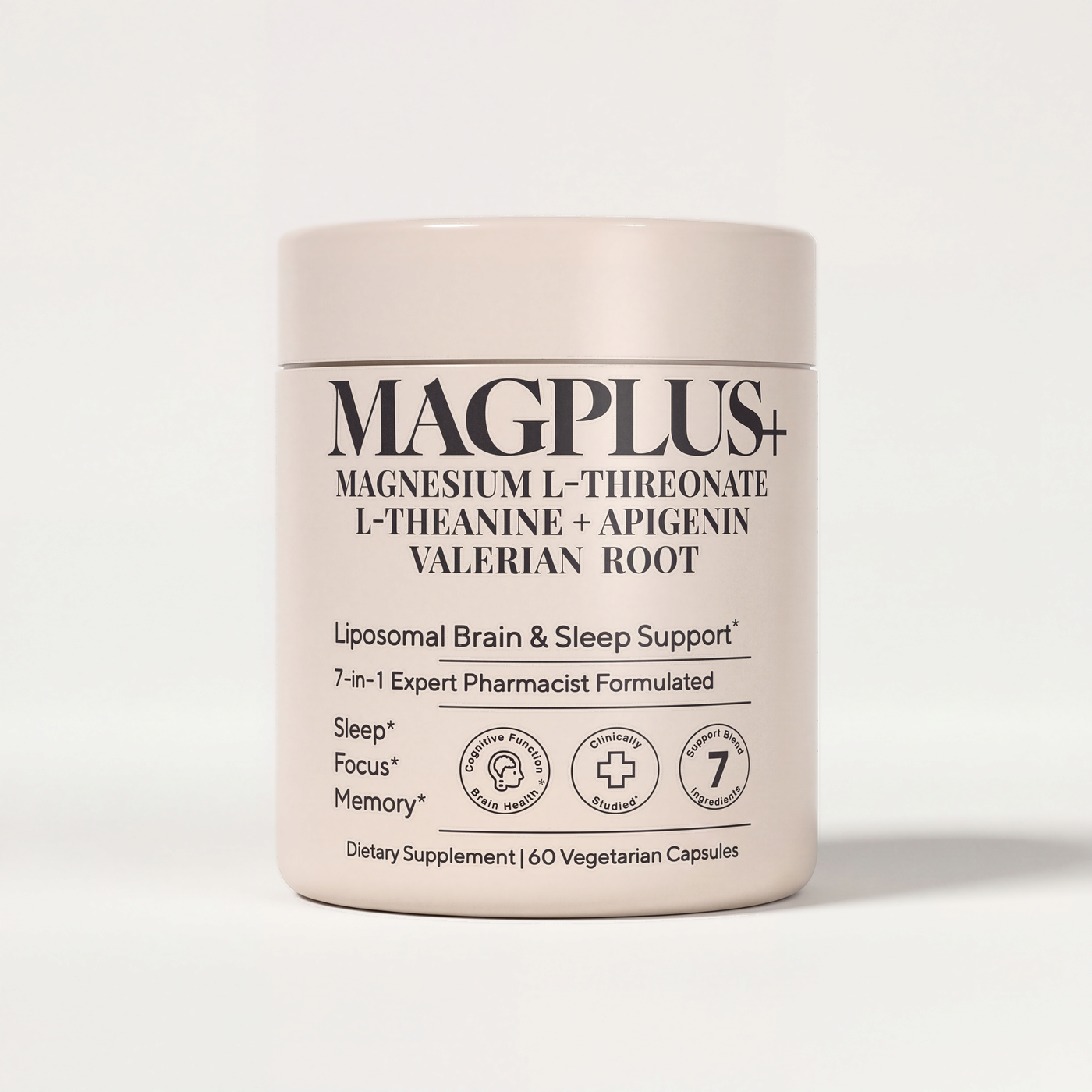
For people who want magnesium glycinate as part of a broader magnesium strategy — one that covers sleep, brain health, muscle, and cardiovascular tissues simultaneously — MAGPLUS+ is formulated with this in mind. It contains Magnesium Glycinate/Bisglycinate as one of 13 distinct magnesium forms, each selected for different tissue affinity and functional role. Rather than forcing a single form to do all the work, MAGPLUS+ uses each form where the research supports it.
If sleep is the primary goal and you want to start with the most targeted form, magnesium glycinate — at 300–400mg elemental per night — is where the evidence points.
References: Bannai et al. (2012), Sleep and Biological Rhythms. Boyle et al. (2017), Nutrients. Rosanoff et al. (2012), Nutrition Reviews. Siebrecht (2013), Journal of the American Nutrition Association. Ates et al. (2019), Magnesium Research.