It happens with frustrating regularity. You fall asleep fine, sleep reasonably well for a few hours — and then you're awake. Wide awake. Brain running. Lying there staring at the ceiling at 3 or 3:30am, wondering what is wrong with you. If this sounds like your life, you're not alone and you're not broken. But the explanation you've probably been given — "you're just a light sleeper" or "it's stress" — leaves out the actual biology. The 3am wake-up is not random. It has a mechanism. And once you understand it, you can do something about it.

How Sleep Actually Works
To understand why you're waking up at 3am, you first need a quick map of what's supposed to be happening while you sleep. Sleep isn't a flat, uniform state. It's a series of 90-minute cycles, each moving through distinct stages: N1 (light sleep, the transition), N2 (consolidated light sleep, where most of your night is spent), N3 (slow-wave deep sleep, the most physically restorative stage), and REM (rapid eye movement sleep, critical for memory consolidation, emotional regulation, and cognitive function).
You cycle through these stages repeatedly across a night. Deep sleep (N3) is heaviest in the first half of the night — your body front-loads physical restoration. REM sleep is heaviest in the second half — the early morning hours from roughly 2am to 6am are when you're doing most of your memory processing and emotional repair work.
This means the hours between 2 and 5am are actually some of the most biologically active of the night. A lot is happening. Which is part of why disruptions tend to cluster there.
The Cortisol Awakening Response
Here's the piece most people have never heard of: cortisol, the body's primary stress and arousal hormone, follows a daily rhythm. It's not just high when you're stressed — it has a built-in daily arc that peaks in the morning to help you wake up, declines through the day, and hits its lowest point in the early part of the night.
But cortisol begins rising again in the early morning hours — typically starting around 3 to 4am — as part of what's called the cortisol awakening response (CAR). This is by design. The body is beginning to prepare for the transition to wakefulness, gradually ramping up arousal, blood pressure, and metabolic activity before you're supposed to actually wake up.
In a well-regulated system, this cortisol rise is smooth and gradual. You sleep through it, complete your final REM cycles, and wake up naturally feeling reasonably alert. But in an under-resourced nervous system — one that's chronically stressed, under-recovered, or running low on key minerals — that cortisol signal isn't gradual. It's a spike. And a cortisol spike at 3am means you're awake at 3am, heart quietly racing, mind already running through tomorrow's problems.

The HPA Axis and Where Magnesium Comes In
The cortisol awakening response is driven by the HPA axis — the hypothalamic-pituitary-adrenal system, the body's core stress regulation pathway. The hypothalamus signals the pituitary, the pituitary signals the adrenal glands, and cortisol is released. This is the system that responds to stress, regulates energy, and manages the arousal cycle.
Magnesium functions as a natural brake on HPA axis activity. It helps regulate how sensitively the hypothalamus fires, how strongly the adrenal glands respond, and how quickly the system returns to baseline after activation. When magnesium levels are adequate, the HPA axis is modulated — cortisol rises are smoother and the system doesn't over-respond.
When magnesium is low, that brake is gone. The HPA axis becomes hyperreactive. The natural 3am cortisol rise — which is supposed to be gentle — becomes an abrupt spike. And you wake up.
This is why magnesium supplementation specifically supports sleep maintenance, not just sleep onset. It's not sedating you. It's addressing the physiological mechanism that's yanking you out of sleep in the first place.
Why Melatonin Won't Fix This
Melatonin has become the default sleep supplement, and for a narrow use case — trouble falling asleep, jet lag, shift work schedule adjustment — it has genuine utility. Melatonin is a timing signal. It tells your brain when it's dark, and darkness means sleep onset. That's the full scope of what it does.
Melatonin does not influence cortisol rhythms. It does not support the GABA system. It does not regulate HPA axis activity. It has no meaningful effect on the 3am cortisol spike or the nervous system hyperexcitability that turns that spike into a full wake-up. Taking melatonin to fix 3am wake-ups is like taking a sleep onset pill for a sleep maintenance problem. You're treating the wrong mechanism entirely.
This is also why a lot of people report that melatonin "stopped working" — it was never working on the right thing.
Blood Sugar: The Secondary Culprit
There's one more factor worth naming: blood sugar. In the early morning hours, the liver begins releasing stored glucose (glycogen) to support rising cortisol and prepare the body for activity. In people with blood sugar regulation challenges — insulin resistance, reactive hypoglycemia, or just a history of high-carb late-night eating — this process can be less smooth, with more pronounced dips and swings.
A significant blood sugar drop at 3am is another reliable wake-up trigger. The body interprets falling blood glucose as a mild emergency and releases adrenaline to mobilize energy stores. Adrenaline at 3am means you're awake at 3am.
Relevant here: magnesium is involved in insulin signaling and glucose metabolism. Adequate magnesium levels support more stable blood sugar regulation, which means fewer of those early-morning glucose-driven wake signals.*
What Actually Addresses the Mechanism
Once you understand the biology, the solution becomes more logical. What you need isn't more melatonin. What you need is:
Support for the GABA system — the brain's primary inhibitory signaling network that keeps the nervous system from staying hyperactivated. Apigenin (a compound found in chamomile that binds to benzodiazepine receptors without dependency), Valerian Root Extract (which increases GABA availability), and L-Theanine (which promotes GABA production and alpha wave brain activity) all work here.*
Cortisol and HPA axis buffering — which comes back to magnesium, specifically in a form that actually reaches the brain. Magnesium L-Threonate is one of the few forms studied for its ability to cross the blood-brain barrier and raise central nervous system magnesium levels, not just peripheral tissue levels.*
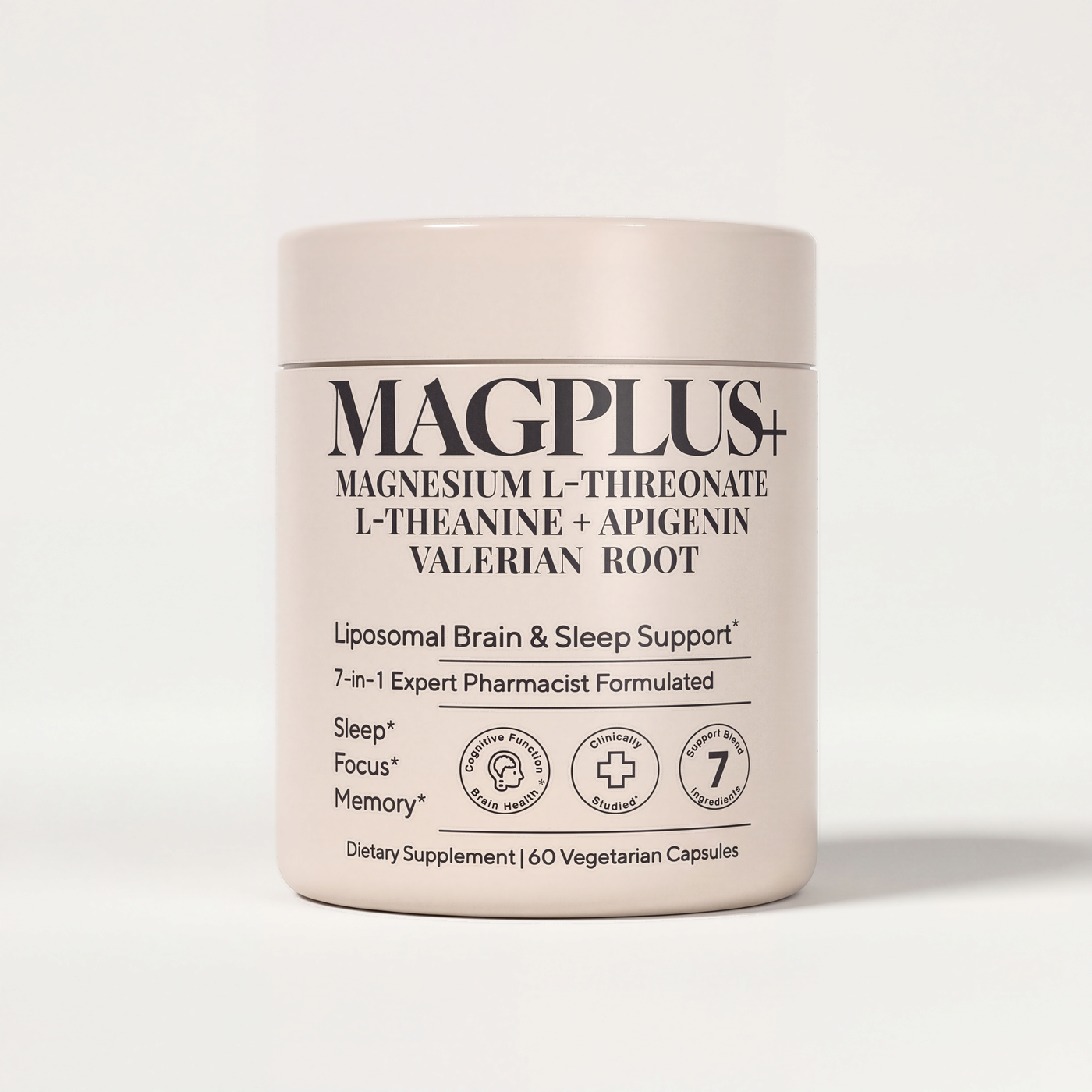
MAGPLUS+ 7-in-1 brings magnesium L-threonate in a liposomal complex together with 200 mg L-theanine, 50 mg apigenin, chamomile and valerian. Seven ingredients for your evening wind-down, without melatonin.* Two capsules make one serving. Follow the directions and cautions on your bottle.
If waking in the middle of the night is a pattern for you, the answer is probably not that you're a "bad sleeper." It's more likely that your nervous system is under-resourced and your cortisol rhythm is misfiring. That's a fixable problem — but it requires addressing the right mechanism.

These statements have not been evaluated by the FDA. This product is not intended to diagnose, treat, cure, or prevent any disease.