Quick Answer: Magnesium glycinate and magnesium L-threonate serve different purposes in different tissues. Glycinate is highly bioavailable and ideal for whole-body magnesium repletion — sleep quality, muscle relaxation, stress reduction, and general wellness. L-threonate was specifically engineered at MIT to cross the blood-brain barrier, making it the form of choice for cognitive function, memory, and brain health. If your primary goal is sleep and relaxation, glycinate. If your primary goal is brain performance and cognitive aging, threonate. For full coverage of both, you need both.
The Supplement Aisle Problem
You're standing in front of the magnesium section, or you've scrolled through enough Amazon listings to feel cross-eyed, and you're facing a version of this: magnesium oxide, citrate, glycinate, malate, L-threonate, taurate, orotate. Twelve products, twelve different names, each claiming to be the best.
Nobody explained to you that these are not the same supplement with different branding. They are chemically distinct compounds with different absorption rates, different tissue targets, and genuinely different effects in the body. Choosing the wrong form is not a minor inefficiency — it can mean taking a supplement for months and getting little from it.
This is one of the most legitimately confusing categories in the supplement world, and the confusion is not your fault. Let's clear it up.
Why Magnesium Form Matters — The Oxide Problem
Before comparing glycinate and threonate, you need to understand why form matters at all — and nothing illustrates this more starkly than magnesium oxide.
Magnesium oxide is cheap. It has a high percentage of elemental magnesium by weight (about 60%), which looks impressive on a label. A capsule can say "500 mg elemental magnesium" while other products seem to deliver far less. This is why it dominates the cheap end of the market.
Here is the problem: magnesium oxide has approximately 4% oral bioavailability. You swallow 500 mg and absorb roughly 20 mg. The rest exits as waste — or, more accurately, as a laxative effect, because unabsorbed magnesium in the colon draws water in via osmosis. That's not a bug in magnesium oxide — it's literally how milk of magnesia (magnesium hydroxide, same principle) works as a laxative.
The fundamental insight is this: for magnesium to absorb well, it needs to be chelated — chemically bound to an organic molecule that helps shepherd it through the intestinal wall. The nature of that chelating molecule is what determines where the magnesium ends up and what it does once it gets there.
This is why glycinate and threonate are not just "better versions of magnesium." They are targeting different tissues, using different transport mechanisms, for genuinely different outcomes.
Magnesium Glycinate: The Sleep and Relaxation Form
Magnesium glycinate is magnesium bound to glycine, a non-essential amino acid. This is one of the best-absorbed forms of magnesium — bioavailability is meaningfully higher than oxide, citrate, or carbonate, and it is significantly gentler on the gastrointestinal tract. Unlike citrate or oxide, glycinate rarely causes GI upset, making it suitable for daily use at therapeutic doses.
The Glycine Effect
Here is what makes glycinate interesting beyond just being "magnesium that absorbs well": glycine itself is an active compound with documented effects on sleep and the nervous system.
Glycine is an inhibitory neurotransmitter in the brainstem and spinal cord. It binds to glycine receptors (GlyR) and NMDA receptors, reducing neuronal excitability and supporting the transition toward rest. Critically, glycine also lowers core body temperature — a key physiological trigger for sleep onset. In a 2012 study by Bannai et al. in Sleep and Biological Rhythms, 3 grams of glycine taken before bed significantly improved subjective sleep quality, reduced sleep latency (time to fall asleep), and meaningfully reduced next-day daytime sleepiness — without morning grogginess or sedation.
When you take magnesium glycinate, you are getting two sleep-supporting agents simultaneously: magnesium and glycine, each operating through different but complementary pathways.
How Magnesium Supports Sleep and Relaxation
Magnesium's relationship with the nervous system runs deep:
- GABA receptor modulation. Magnesium activates GABA-A receptors, the brain's primary inhibitory neurotransmitter system. This is the same receptor family that benzodiazepines (like Valium) work on — though magnesium's action is far gentler and natural. Supporting GABAergic tone promotes the calm, settling feeling that precedes sleep onset.
- NMDA receptor blockade. Magnesium is a voltage-dependent blocker of NMDA glutamate receptors. This reduces excessive excitatory neuronal activity — the mental "noise" that makes it hard to wind down at the end of the day. When magnesium is depleted, NMDA receptors become hyperactive, contributing to anxiety, rumination, and difficulty switching off.
- HPA axis regulation. Magnesium modulates the hypothalamic-pituitary-adrenal (HPA) axis, reducing cortisol output. Chronically elevated evening cortisol is one of the most common physiological drivers of sleep-onset difficulty and poor sleep quality.
- Melatonin synthesis support. Magnesium is a required cofactor for serotonin N-acetyltransferase, the enzyme that converts serotonin to melatonin. Magnesium deficiency can impair your body's ability to produce its own melatonin — before you even consider whether to take melatonin as a supplement.
- Muscle relaxation. Magnesium competes with calcium at neuromuscular junctions, promoting muscle relaxation. This is why magnesium deficiency is strongly associated with nighttime muscle cramps, restless legs, and tension that interferes with comfortable sleep.
The Magnesium Deficiency Reality
Here is the context that makes all of this relevant: magnesium deficiency is extraordinarily common. The NHANES surveys consistently show that approximately half of American adults do not meet the RDA for magnesium from diet alone — and that's using the RDA, which many researchers consider conservative. Modern food processing strips magnesium from grains; soil depletion has reduced magnesium content in produce; stress accelerates magnesium excretion through urine; alcohol and certain medications (especially diuretics and proton pump inhibitors) further deplete it.
If you are chronically sleep-disrupted, anxious, tense, cramping at night, and eating a standard Western diet, a meaningful probability exists that magnesium deficiency is a contributing factor — not a root cause, but a compounding variable that makes everything worse.
Magnesium glycinate addresses this directly. It restores whole-body magnesium status efficiently, without GI distress, while delivering glycine as a bonus sleep-supporting co-pilot.
Who magnesium glycinate is for: - Poor sleep quality and difficulty winding down - Stress and anxiety with physical tension - Nighttime muscle cramps or restless legs - General magnesium repletion for people eating a standard Western diet - Anyone who has tried magnesium before and experienced GI discomfort from citrate or oxide forms
Magnesium L-Threonate: The Brain Form
Magnesium L-threonate is a fundamentally different animal. It is not simply "another well-absorbed form of magnesium." It was invented specifically to solve a problem that other forms cannot: how do you reliably raise magnesium levels inside the brain?
The Blood-Brain Barrier Problem
The brain is protected by the blood-brain barrier (BBB), a selective membrane that strictly controls what passes from the bloodstream into the central nervous system. Most supplements cannot meaningfully cross it. Magnesium, despite being essential for brain function, does not cross the BBB efficiently in its standard forms — even when blood magnesium levels are adequately maintained, brain magnesium can remain suboptimal.
This is the problem that Dr. Guosong Liu and colleagues at MIT set out to solve. Their research, published in 2010 in the journal Neuron — one of the most prestigious neuroscience publications in the world — demonstrated that they had succeeded.
The MIT Discovery
The key insight was threonate, a small molecule that is a metabolite of vitamin C. Threonate can be transported across the blood-brain barrier via GLUT transporters — glucose transporters that are abundantly expressed on BBB endothelial cells. By binding magnesium to threonate, the resulting compound (magnesium L-threonate) gains access to a transport mechanism not available to other magnesium forms.
The 2010 Slutsky et al. study in rodents demonstrated: - Oral magnesium L-threonate increased cerebrospinal fluid threonate concentrations by 54% - Brain magnesium levels increased by approximately 15% — a magnitude not achieved by any other tested magnesium form - Synaptic density in the hippocampus increased measurably - Cognitive deficits (working memory, short-term memory, long-term memory) were reversed in aging rodent models
This was not a supplement company's study. It was MIT-originated, peer-reviewed neuroscience published in a Cell Press journal.
Human Clinical Evidence
The animal findings led to human trials, and the results have continued to accumulate:
Frontiers in Aging Neuroscience, 2016 — A randomized, double-blind, placebo-controlled trial in older Chinese adults found significant improvements in executive function and working memory after magnesium L-threonate supplementation compared to placebo. Cognitive improvements were particularly pronounced in participants with the greatest baseline cognitive decline.
Frontiers in Nutrition, 2025 (Australian RCT) — One hundred adults aged 18–45 were randomized to magnesium L-threonate or placebo for six weeks. The threonate group showed a 7.5-year reduction in brain cognitive age as measured by standardized cognitive testing, along with significant improvements in working memory, episodic memory, reaction time, and the NIH Total Cognition Composite score. This is the most rigorous recent human trial, and its findings have driven renewed mainstream interest in the form.
Nutrients, 2022 (Liu et al.) — 109 healthy adults treated with magnesium L-threonate combined with phosphatidylserine for 12 weeks showed significant improvements across all five subcategories of the Clinical Memory Test, with larger gains in older participants.
Sleep Health, 2024 (Zhang et al.) — 80 adults aged 35–55 with documented sleep problems received 1 gram/day of magnesium L-threonate for 21 days. The threonate group showed greater improvement in sleep-related impairment measures (Insomnia Severity Index, Leeds Sleep Evaluation Questionnaire). Importantly, objective sleep improvement was most pronounced in participants with the most severe baseline sleep problems.
What Magnesium L-Threonate Does in the Brain
When threonate successfully delivers magnesium across the BBB, the neurological effects are distinct from whole-body magnesium repletion:
- NR2B-NMDA receptor upregulation. MgT increases expression of the NR2B subunit of NMDA receptors in the hippocampus and prefrontal cortex. NR2B-containing NMDA receptors have longer open times and are critical for long-term potentiation (LTP) — the process by which synaptic connections strengthen with learning. More NR2B = better LTP = improved learning and memory formation.
- Synaptic density increase. MgT increases the density of synaptic puncta in hippocampal regions CA1, CA3, and the dentate gyrus — regions critical for memory encoding and consolidation.
- Presynaptic optimization. Increases functional presynaptic release sites while reducing individual release probability — a "signal-to-noise" improvement where synapses respond more robustly to meaningful signals (learning inputs) and less to background noise.
- BDNF upregulation. Increases brain-derived neurotrophic factor, the protein often described as "fertilizer for the brain" that supports neurogenesis, synaptic plasticity, and cognitive resilience.
Who magnesium L-threonate is for: - Cognitive function support — focus, clarity, learning, working memory - Memory maintenance and age-related cognitive health - Anyone over 40 interested in the long game of brain aging - Entrepreneurs, students, or high performers wanting neurological optimization - People specifically interested in raising brain magnesium, not just blood magnesium
The Coverage Map: Brain vs. Body
Here is the clearest way to frame the glycinate vs. threonate question — not as a competition, but as a coverage map.
Magnesium glycinate: covers the body. Efficiently restores whole-body magnesium status, supports the nervous system broadly, improves sleep via GABA and muscle relaxation pathways, reduces anxiety and tension, addresses deficiency.
Magnesium L-threonate: targets the brain. Specifically increases magnesium within the central nervous system, supports synaptic density and plasticity, improves cognitive function and memory, does not reliably address whole-body magnesium deficiency at the doses typically used.
This distinction has a practical implication: if you are severely magnesium deficient and you take threonate to "fix it," you are likely to see cognitive benefits but continued whole-body symptoms — because threonate's elemental magnesium content is low (approximately 7.2% by weight, compared to oxide at 60% or citrate at 16%) and its mechanism targets CNS delivery rather than systemic magnesium restoration.
Conversely, if you take glycinate hoping for the cognitive and memory benefits documented in the threonate research, you are likely to improve sleep and feel more relaxed — but you will not be meaningfully raising brain magnesium in the way threonate does, because glycinate does not cross the blood-brain barrier via the GLUT transporter pathway.
They are not the same product optimized for different preferences. They are genuinely different tools.
Other Magnesium Forms Worth Knowing
For context, the broader magnesium landscape includes forms worth briefly understanding:
Magnesium malate — bound to malic acid, a Krebs cycle intermediate involved in energy production. Some evidence for supporting energy metabolism and reducing muscle fatigue. A reasonable choice for people primarily interested in daytime energy.
Magnesium taurate — bound to taurine, with evidence for cardiovascular support. Taurine itself has documented effects on blood pressure and cardiac function. A reasonable choice for cardiovascular-focused supplementation.
Magnesium orotate — bound to orotic acid, used historically in some European countries for cardiac applications. Limited but interesting research in heart failure outcomes.
Magnesium citrate — commonly used form with decent bioavailability. More likely to cause loose stools than glycinate at equivalent doses. Adequate but not ideal for daily use at higher doses.
Magnesium oxide — cheapest, most common, lowest bioavailability (~4%). Use as a laxative, not as a magnesium supplement. The supplement world's version of a trap door.

The Stack Approach: Using Both
Given their complementary coverage zones, the intelligent approach for many people — particularly those wanting both sleep optimization and cognitive support — is to use glycinate and threonate together.
This is not a new idea. Formulas combining the two forms are designed specifically around this dual-coverage principle: threonate for targeted brain magnesium elevation, glycinate for whole-body repletion, sleep, and the synergistic glycine effect. Together, they address both the systemic deficiency that affects most adults eating a Western diet and the brain-specific magnesium elevation that threonate alone makes possible.
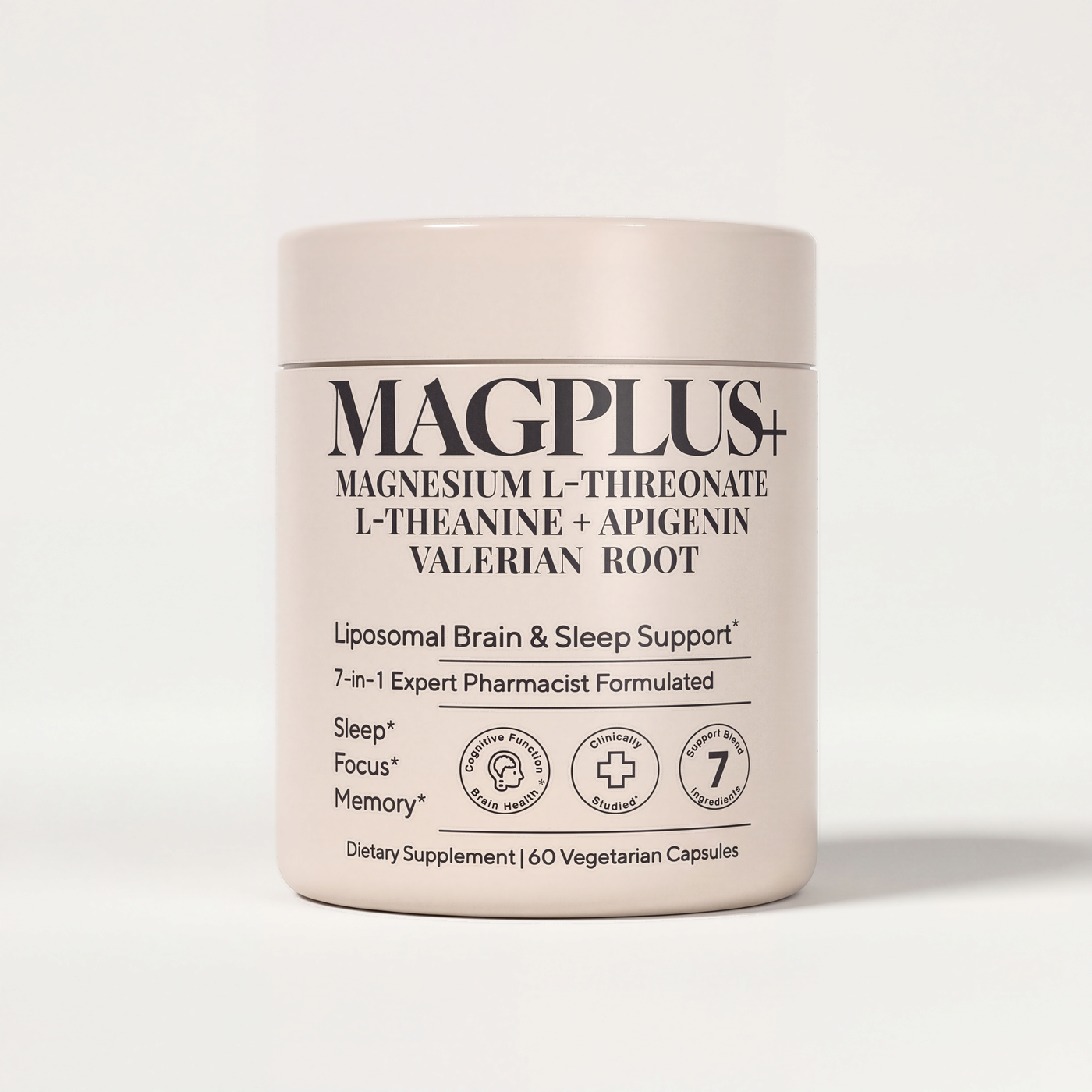
The MAGPLUS formula from Plus+Ultra uses exactly this architecture — magnesium L-threonate (Magtein, the MIT-patented form) in a liposomal complex alongside the broader sleep formula — ensuring brain-targeted delivery while supporting the full spectrum of sleep, relaxation, and recovery benefits.
Dose and Timing Guidance
Magnesium glycinate: - Effective range: 200–400 mg of elemental magnesium per day - Best timing: evening, 30–60 minutes before bed - Dosing note: glycinate is well-tolerated at higher doses; GI issues are rare. If you experience any loose stools, reduce dose and build up gradually - Away from calcium (calcium and magnesium compete for absorption via shared intestinal transporters)
Magnesium L-threonate: - Effective range: 1,000–2,000 mg of the magnesium L-threonate compound (note: this delivers far less elemental magnesium than it sounds — approximately 72–144 mg elemental Mg at these doses, due to the low elemental percentage) - The 2024 Zhang sleep trial used 1,000 mg/day with significant results; the 2025 Frontiers in Nutrition cognitive trial used a standard Magtein dose - Can be taken day or night; some users take it in the morning for cognitive benefits during the day, others take it at night for combined cognitive/sleep benefits - Also away from calcium for the same absorption reasons
If stacking both: a practical approach is glycinate at night as part of your sleep routine, and threonate earlier in the day or combined with your evening glycinate dose if you prefer consolidating your supplementation.
Frequently Asked Questions
What is the best form of magnesium?
"Best" depends entirely on your goal. For sleep, relaxation, and whole-body magnesium repletion: glycinate. For brain health, cognition, and memory: L-threonate. For both: use both. Avoid oxide for anything other than occasional constipation relief.
Does magnesium glycinate help with sleep?
Yes — and the evidence is meaningful. Magnesium supports GABA activity, reduces cortisol, enables melatonin production, and relaxes muscles. The glycine component of glycinate has independent evidence for improving sleep quality and reducing daytime sleepiness (Bannai et al., 2012). The combination creates a synergistic calming effect without sedation or morning grogginess.
Can magnesium improve memory?
Magnesium L-threonate specifically has clinical evidence for improving memory — the 2016 Frontiers in Aging Neuroscience trial showed improvements in executive function and working memory in older adults, and the 2025 Frontiers in Nutrition trial showed a 7.5-year reduction in brain cognitive age along with improved episodic and working memory in adults 18–45. Standard magnesium forms (glycinate, citrate, etc.) do not have equivalent evidence for memory specifically, because they do not reliably elevate brain magnesium.
What is magnesium L-threonate used for?
Magnesium L-threonate is specifically used for cognitive support: memory, focus, learning, and protection against age-related cognitive decline. It was developed at MIT for the purpose of crossing the blood-brain barrier to raise brain magnesium levels — something other forms cannot do reliably. It also has emerging evidence for sleep quality improvement in people with sleep difficulties.
Is magnesium threonate worth the extra cost?
If brain health and cognitive function are priorities for you — yes. The Magtein patent, the MIT research, and the now-replicated human clinical trials justify the premium for a population of users for whom cognitive aging, memory, or mental performance is a primary concern. If your only goal is better sleep and general magnesium repletion, glycinate is significantly more cost-effective.
Can you take both magnesium glycinate and threonate together?
Yes — and for many people, this is the optimal approach. They work in different tissue compartments (body vs. brain), use different mechanisms, and their effects are additive rather than redundant. There are no known safety concerns with combining the two forms at standard doses. The main consideration is total magnesium intake: stay within the supplemental upper tolerable limit of 350 mg elemental magnesium from supplements (this is the UL for supplemental magnesium; dietary magnesium from food does not count toward this limit).
Key Takeaways
- Magnesium form determines where and how it works — form is not a marketing variable, it is a functional one
- Magnesium oxide is almost entirely unabsorbed (~4% bioavailability) and is not a meaningful magnesium supplement
- Magnesium glycinate is highly bioavailable, supports whole-body magnesium repletion, and is ideal for sleep, relaxation, muscle recovery, and stress support — the glycine component adds independent sleep-quality benefits
- Magnesium L-threonate was invented at MIT specifically to cross the blood-brain barrier via GLUT transporters, raising brain magnesium by ~15% in initial research — other forms cannot achieve this
- Multiple human RCTs now support threonate's effects on cognition, memory, and cognitive aging; the 2025 Frontiers in Nutrition trial showed a 7.5-year reduction in brain cognitive age
- The two forms serve complementary roles (body coverage vs. brain coverage) and can be combined effectively
- Threonate at effective doses delivers less elemental magnesium than glycinate, so people with whole-body deficiency benefit from having both in their protocol
- Evening timing works well for glycinate; threonate can be taken day or night depending on personal goals
Related Reading
- Why Most People Are Magnesium Deficient (And Don't Know It)
- How Sleep Architecture Works — and What Disrupts It
- GABA, Glutamate, and the Chemistry of Winding Down
- The Science of Phosphatidylserine and Cortisol
Evidence References
-
Slutsky I, Abumaria N, Wu LJ, et al. Enhancement of learning and memory by elevating brain magnesium. Neuron. 2010;65(2):165-177.
-
Liu G, Weinger JG, Lu ZL, Xue F, Sadeghpour S. Efficacy and safety of MMFS-01, a synapse density enhancer, for treating cognitive impairment in older adults: a randomized, double-blind, placebo-controlled trial. Journal of Alzheimer's Disease. 2016;49(4):971-990.
-
Zhang C, Hu Q, Li S, et al. A magtein, magnesium L-threonate based formula improves brain cognitive functions in healthy Chinese adults. Nutrients. 2022;14(24):5235.
-
Zhang Y, Xun P, Wang R, Mao L, He K. Can magnesium enhance exercise performance? Nutrients. 2017;9(9):946.
-
Frontiers in Nutrition. Magnesium L-threonate supplementation improved cognitive performance and reduced brain cognitive age by 7.5 years in a randomized controlled trial. Frontiers in Nutrition. 2025 (Australian RCT).
-
Zhang J, Mai CL, Xiong Y, et al. The causal role of magnesium deficiency in the neuroinflammation, pain hypersensitivity and memory/emotional deficits in ovariectomized and aged female mice. Journal of Inflammation Research. 2021;14:6634-6656.
-
Bannai M, Kawai N. New therapeutic strategy for amino acid medicine: glycine improves the quality of sleep. Journal of Pharmacological Sciences. 2012;118(2):145-148.
-
Bannai M, Kawai N, Ono K, Nakahara K, Murakami N. The effects of glycine on subjective daytime performance in partially sleep-restricted healthy volunteers. Frontiers in Neurology. 2012;3:61.
-
Abbasi B, Kimiagar M, Sadeghniiat K, Shirazi MM, Hedayati M, Rashidkhani B. The effect of magnesium supplementation on primary insomnia in elderly: A double-blind placebo-controlled clinical trial. Journal of Research in Medical Sciences. 2012;17(12):1161-1169.
-
Boyle NB, Lawton C, Dye L. The effects of magnesium supplementation on subjective anxiety and stress — a systematic review. Nutrients. 2017;9(5):429.
-
Held K, Antonijevic IA, Künzel H, et al. Oral Mg2+ supplementation reverses age-related neuroendocrine and sleep EEG changes in humans. Pharmacopsychiatry. 2002;35(4):135-143.
-
Cao Y, Zhen S, Taylor AW, Appleton S, Atlantis E, Shi Z. Magnesium intake and sleep disorder symptoms: findings from the Jiangsu Nutrition Study of Chinese adults at five-year follow-up. Nutrients. 2018;10(10):1354.
-
Brilli E, Khadge S, Garavaglia C, et al. Magnesium bioavailability after administration of a new organic Mg compound. Magnesium Research. 2022;35(1):1-9.
-
Monteleone P, Maj M, Beinat L, Natale M, Kemali D. Blunting by chronic phosphatidylserine administration of the stress-induced activation of the hypothalamo-pituitary-adrenal axis in healthy men. European Journal of Clinical Pharmacology. 1992;42(4):385-388.