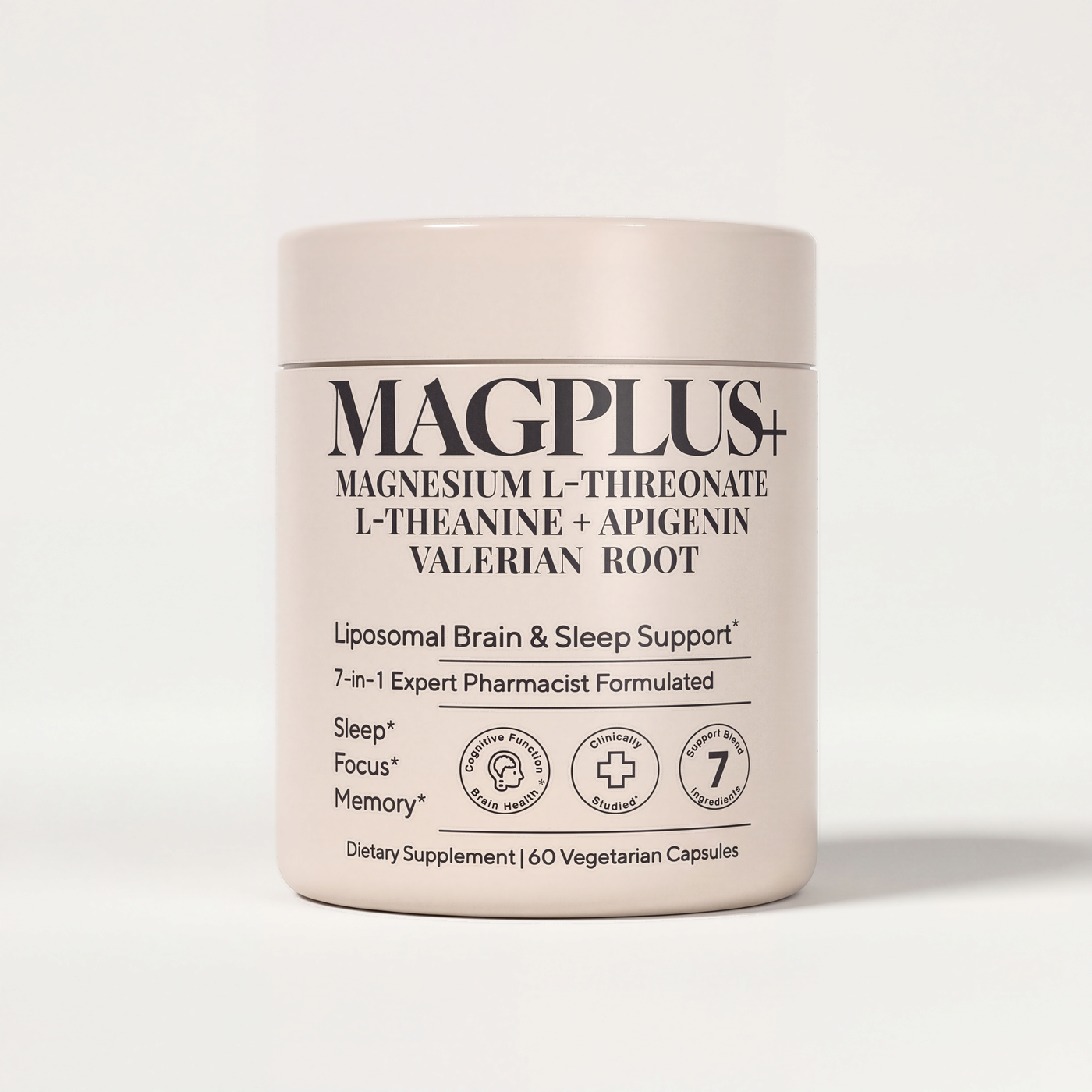
Quick Answer: Sleep commonly deteriorates in your 40s and 50s due to five compounding biological changes: declining magnesium absorption, collapse of deep slow-wave sleep, reduced melatonin production, HPA axis cortisol dysregulation, and — in women — estrogen and progesterone withdrawal. These changes are documented and physiologically distinct from the sleep problems of younger adults. Magnesium L-threonate addresses the deep sleep architecture deficit by raising brain magnesium levels. Magnesium glycinate addresses the HPA axis and GABA-receptor changes driven by progesterone decline. Generic sleep hygiene alone doesn't touch any of these mechanisms.

If you're over 50 and your sleep has quietly gotten worse over the past few years — harder to fall asleep, waking up in the middle of the night, lying there unable to get back to sleep, then dragging through the next day feeling like you got maybe half the rest you needed — you are not imagining it.
And it's probably not just stress.
There's a tendency to attribute worsening sleep in midlife to life circumstances: a demanding job, growing kids or aging parents, financial pressure, a global whatever. Those things are real and they matter. But they don't explain the full picture. Even people who are genuinely less stressed than they were at 35 often find their sleep has gotten meaningfully worse by 55.
The reason is that the biological machinery that generates good sleep is changing in your body right now, in ways that are well-documented, measurable, and largely independent of how your life is going. Understanding what's actually happening is the first step toward doing something useful about it.
Five Biological Changes After 50 That Directly Affect Sleep
1. Magnesium Absorption Declines
This is one of the least discussed and most consequential changes in the physiology of aging.
Magnesium absorption in the gut depends on intestinal transport proteins that become progressively less efficient with age. Simultaneously, aging kidneys excrete more magnesium in the urine. The result is that even when dietary magnesium intake is technically adequate — meeting the recommended 320-420mg per day — serum and cellular magnesium levels often still fall short.
Large epidemiological surveys have consistently found that magnesium intake drops below the recommended levels for a significant portion of adults over 50, even in developed countries with generally adequate diets. But the absorption and retention problem means the gap between intake and adequacy is even wider than dietary surveys suggest.
This matters for sleep because magnesium is involved in regulating nearly every system that produces good sleep: the HPA axis and cortisol regulation, GABA-A receptor function, NMDA receptor inhibition, melatonin synthesis, and muscle relaxation. When magnesium status declines, all of these systems degrade simultaneously — in subtle, compounding ways that manifest as progressively worse sleep over time.
2. Deep Sleep Collapses
Of all the changes to sleep architecture that occur with aging, the decline in slow-wave sleep (SWS, or N3 — the deepest stage) is the most dramatic and the most directly connected to how rested you feel.
In young adults, slow-wave sleep typically represents 20-25% of total sleep time. By the time you're in your 60s, it can fall to 5-10% — or, in some individuals, become nearly absent. This is not a marginal difference. Deep sleep is the stage in which growth hormone is secreted, cellular repair occurs, the glymphatic system clears metabolic waste from the brain, and immune function is consolidated.
When deep sleep is abundant, you wake up feeling genuinely restored. When it's deficient, you can spend nine hours in bed and still feel like the sleep didn't work. That's because it mostly didn't — you cycled through light sleep and REM without spending meaningful time in the physically restorative depth.
This decline in slow-wave sleep is not inevitable or completely fixed. It is, however, the specific mechanism that magnesium L-threonate most directly targets.
3. Melatonin Production Declines
The pineal gland, which produces melatonin in response to darkness, undergoes progressive calcification with age. This process, sometimes called "pineal gland aging," reduces the volume of functional pineal tissue and therefore the amount of melatonin secreted.
Melatonin does more than make you sleepy. It acts as the primary circadian signal that tells your body it's nighttime — triggering the cascade of hormonal and neurological changes (including the suppression of cortisol) that enables sleep. When melatonin output is reduced, this signal is weaker. The transition to sleep becomes less automatic. And critically, the nighttime suppression of cortisol becomes less complete, leaving you more vulnerable to the early-morning cortisol spike that characterizes 3am waking.
Melatonin supplementation in older adults has modest but real evidence behind it for reducing sleep onset latency. But it doesn't address the deeper architectural changes in sleep stages, which is why it often "sort of helps" but doesn't feel like the full answer.
4. Cortisol Dysregulation — The HPA Axis Shifts
The HPA axis — the hypothalamic-pituitary-adrenal system that governs cortisol production — changes in its regulatory sensitivity with aging. Two effects are particularly relevant to sleep:
First, cortisol clearance becomes less efficient. Cortisol that would normally be metabolized and cleared from the bloodstream overnight lingers longer, maintaining a baseline of alerting signal that competes with sleep.
Second, the cortisol awakening response (the natural cortisol surge that prepares your body for waking) becomes less precisely timed. In younger adults, this surge typically fires close to the intended wake time. In older adults, it often fires earlier — sometimes by several hours — producing the characteristic 3am or 4am wake-up that becomes increasingly common in midlife.
Both of these effects are compounded by the reduced melatonin described above. Melatonin normally buffers the nocturnal cortisol signal; with less melatonin, even a modestly early cortisol surge is sufficient to break through lighter sleep stages.
Magnesium directly modulates HPA axis activity. Adequate magnesium is required for the pituitary's regulation of ACTH (the signal that tells the adrenals to produce cortisol). Magnesium deficiency — which, as described above, is increasingly common after 50 — removes a natural brake on cortisol production, amplifying the HPA dysregulation that aging is already producing.
5. The Hormone Withdrawal Effect — Specific to Women
For women, the hormonal changes of perimenopause and menopause add a fifth layer of sleep disruption that is entirely separate from the mechanisms above.
Progesterone decline is the most directly sleep-relevant of these changes. Progesterone is a natural GABA-A receptor agonist — it activates the same receptor pathway that benzodiazepines and alcohol do (albeit gently and naturally). This GABAergic effect is calming, sleep-promoting, and one reason many women slept better during the progesterone-dominant luteal phase of their menstrual cycle. As progesterone declines in perimenopause, this natural sleep support disappears. The nervous system becomes more excitable at baseline. Sleep onset becomes harder.
Estrogen withdrawal triggers the vasomotor symptoms that most women know as hot flashes and night sweats. These episodes of sudden heat and flushing are caused by dysregulated vasodilation — a downstream effect of estrogen's role in temperature regulation. Night sweats that wake you from sleep are not just uncomfortable; they represent a literal arousal from sleep, and repeated arousals fragment sleep architecture in ways that accumulate over weeks and months into a pattern of chronically non-restorative sleep.
Additionally, urinary frequency often increases with age and with pelvic floor changes related to estrogen decline, adding another source of nighttime waking that has nothing to do with cortisol or sleep architecture directly.
Why Sleep Advice Designed for 30-Year-Olds Doesn't Work at 50
Most sleep hygiene content is implicitly written for people whose primary sleep problem is behavioral or environmental — too much screen time, irregular schedules, too much caffeine, too much alcohol. These are real problems, and the standard advice addresses them appropriately.
But these interventions don't:
- Restore declining magnesium absorption
- Reverse the collapse of slow-wave sleep
- Compensate for reduced melatonin output
- Correct HPA axis cortisol timing
- Replace the GABAergic calming effect of lost progesterone
When someone over 50 implements perfect sleep hygiene — consistent schedule, dark room, no screens, no caffeine after noon — and still sleeps poorly, it's because the problem isn't behavioral. The biology underneath the behavior has changed. You can optimize the behavioral environment all you want; if the hormonal and nutritional substrate is depleted, the optimization has a low ceiling.
This is not a counsel of despair. It's a redirection toward the interventions that actually match the mechanism.

The Magnesium Connection to Sleep After 50, Specifically
Two forms of magnesium are most relevant to the post-50 sleep picture, and they address different components of the problem.
Magnesium L-threonate for slow-wave sleep.
The research connection between magnesium status and deep sleep is most clearly visible in older adults, precisely because this is the population in which both magnesium status and slow-wave sleep have declined most.
Zhang et al. (2022), in a large analysis of magnesium intake and sleep quality, found that higher magnesium was associated with improved sleep efficiency, reduced nighttime awakenings, and better slow-wave sleep — effects most pronounced in older adults. The proposed mechanism is straightforward: brain magnesium levels directly regulate GABA-A receptor density and efficiency, which is the central pathway through which deep sleep is generated. Threonate's documented ability to cross the blood-brain barrier and raise brain magnesium concentrations (Slutsky et al., 2010, Neuron) makes it the most direct tool for addressing the SWS deficit.
Magnesium glycinate for HPA axis and GABA-receptor support.
As progesterone declines in women, the GABAergic tone of the nervous system decreases. Magnesium glycinate addresses this through two pathways: magnesium's own NMDA receptor inhibition (reducing excitatory signaling) and the direct GABA-modulatory effect of glycine (the amino acid chelated to the magnesium). The combination partially compensates for the lost progesterone contribution to GABAergic calm.
For the cortisol dysregulation piece, glycinate's HPA axis modulation (per Boyle et al., 2017, Nutrients) is most relevant — it reduces both baseline cortisol and the sensitivity of the stress response, addressing the early-morning waking pattern that becomes common after 50.
What Lifestyle Levers Actually Work Differently Over 50
The standard sleep hygiene advice isn't useless after 50 — it just isn't sufficient on its own, and some interventions work particularly well for the specific changes of this age group.
Consistent wake time, not just bedtime.
Circadian rhythm is primarily anchored by wake time, not bedtime. Going to bed at the same time doesn't stabilize your circadian clock nearly as well as waking at the same time does — even on weekends, even when you slept poorly. This matters more after 50 because the circadian clock becomes less robust with aging. Social jet lag (varying wake time by more than 90 minutes between weekdays and weekends) is more destabilizing for older adults than for younger ones.
Cooler sleep environment.
Core body temperature drop is one of the triggers for slow-wave sleep onset. The bedroom temperature that optimizes this drop is generally between 65-68°F (18-20°C). For women experiencing night sweats, the temperature management challenge is more complex — but erring toward cooler is almost always correct. Breathable, moisture-wicking bedding can make a meaningful difference for vasomotor-related sleep fragmentation.
Resistance training.
This is underappreciated as a sleep intervention. Kline et al. (2011), in a randomized controlled trial published in Mental Health and Physical Activity, found that 16 weeks of resistance training significantly improved sleep quality, sleep efficiency, and slow-wave sleep duration in sedentary older adults — independent of changes in body composition or aerobic fitness. The proposed mechanisms include: increased growth hormone secretion (which is released primarily during SWS and also drives SWS initiation), improved insulin sensitivity (reducing nocturnal blood glucose volatility), and reduction in HPA axis reactivity.
Two to three sessions per week of moderate-intensity resistance training appears to be sufficient for the sleep benefit. It doesn't need to be intense or high-volume.
Limiting alcohol, especially after 50.
Alcohol suppresses both slow-wave sleep and REM sleep, the two most psychologically and physically restorative stages. In younger adults, some SWS rebound occurs in the second half of the night. In older adults with already reduced SWS capacity, this rebound is weaker and alcohol's suppressive effect has a larger proportional impact on already-limited deep sleep. The same glass of wine that felt benign at 35 may be meaningfully disrupting sleep quality at 55. This isn't moralizing — it's physiology.
FAQ
Why can't I sleep through the night anymore at 50?
Several mechanisms converge simultaneously. Sleep architecture gets lighter — you spend less time in deep sleep and more time in stages you can be easily roused from. Melatonin production declines, weakening the nighttime cortisol-suppression signal. The HPA axis becomes less precise in its cortisol timing, increasing the likelihood of an early-morning cortisol surge that pulls you awake. And for women, the hormone changes of perimenopause add vasomotor disruption and reduced GABAergic tone. All of these operate independently of how much stress you're under.
Does menopause cause sleep problems?
Yes, through several documented mechanisms. Progesterone decline removes a natural GABAergic calming effect on the nervous system, making sleep onset harder and sleep lighter. Estrogen withdrawal triggers hot flashes and night sweats that physically fragment sleep throughout the night. The accompanying HPA axis changes make cortisol timing less precise. Studies consistently show that sleep quality declines significantly around the menopausal transition, with the perimenopausal period often being the most disruptive.
What is the best sleep supplement for women over 50?
The most evidence-supported approach combines magnesium glycinate (for GABA support and HPA axis regulation) with magnesium L-threonate (for deep sleep architecture) and L-theanine (for sympathetic nervous system downregulation and alpha-wave promotion). Magnesium glycinate's glycine component partially compensates for the GABAergic tone lost with progesterone decline. This combination addresses the specific biology of post-menopausal sleep without sedation or dependency concerns.
Does magnesium improve deep sleep?
Yes, particularly in people who are magnesium deficient — which is a disproportionate share of adults over 50. Brain magnesium levels directly regulate GABA-A receptor efficiency, which is the central pathway through which slow-wave sleep is initiated and maintained. Magnesium L-threonate, which is the only form with demonstrated blood-brain-barrier penetrance, is most specifically targeted to this mechanism. Research by Zhang et al. (2022) found significant associations between magnesium status and slow-wave sleep duration in older adults, with the relationship strongest in those with baseline magnesium insufficiency.
Can ashwagandha help with menopause sleep problems?
There is reasonable evidence for ashwagandha (KSM-66 or Sensoril extracts) reducing cortisol and HPA axis reactivity, which addresses the stress-driven component of menopausal sleep disruption. A 2019 study by Pratte et al. and a 2012 randomized trial by Chandrasekhar et al. (Indian Journal of Psychological Medicine) both found significant reductions in perceived stress and cortisol-related markers with ashwagandha supplementation. For women whose sleep disruption is primarily driven by stress-axis hyperarousal, ashwagandha can be a meaningful addition alongside magnesium. It doesn't address hot flashes directly, but reducing HPA-axis reactivity reduces the overall arousal burden.
How long until magnesium improves my sleep?
It depends on the form and the mechanism being addressed. Glycine's effects on NMDA receptors and core body temperature can be noticed within 1-3 nights. Magnesium's HPA axis regulation effects build over 2-4 weeks as systemic magnesium levels normalize. Magnesium L-threonate's deep sleep architecture effects are the most cumulative — brain magnesium repletion takes 4-6 weeks of consistent nightly dosing. Don't assess the full benefit at two weeks. Give it a 30-45 day consistent trial and track your sleep quality (or morning restedness) across the whole period.
This article is educational in nature. The biological changes described affect people differently, and individual variation is significant. If your sleep problems are severe or accompanied by symptoms like snoring, breathing pauses, or excessive daytime fatigue, consult a physician to evaluate for conditions like sleep apnea before attributing the problem to age-related changes.