Quick Answer: Binders are compounds that bind to substances in the GI tract — heavy metals, endotoxins, mycotoxins, certain bile acids — and carry them through to fecal excretion without allowing absorption into systemic circulation. They work exclusively in the gut. They do not enter the bloodstream, and they do not chelate metals from tissue. The primary types are activated charcoal (broad-spectrum adsorption via van der Waals forces), zeolite clinoptilolite (selective metal cation binding via ion exchange), and fiber-based binders (gel-forming compounds that slow reabsorption). All binders must be taken well away from medications, supplements, and meals.

"Detox" Is a Broken Word. Binders Are the Real Thing.
"Detox" has become one of the most abused words in the supplement industry. Juice cleanses marketed to flush toxins — with no defined mechanism, no identified toxin, and no evidence they do anything other than restrict calories. Teas promoted as liver cleanses. Charcoal everything, with packaging suggesting it will undo a weekend of bad decisions.
Against that backdrop, it's reasonable to be skeptical when someone invokes detoxification in a supplement context.
But binders are different. They are a mechanistically specific category with genuine clinical applications. Activated charcoal has been a cornerstone of emergency medicine toxicology since the 1960s — it's in every hospital formulary. Zeolite clinoptilolite has a documented ion exchange mechanism that has been studied in peer-reviewed research. These are not invented wellness concepts. They're applied chemistry.
The problem isn't the compounds. It's the vagueness around what they actually do, how they work, and when using them is rational. Once you understand the mechanism precisely, you can use them intelligently — or not use them, having made an informed decision.
Here's the actual science.
What a Binder Is, Precisely
A binder is a compound that:
- Is ingested orally
- Reaches the GI tract without being absorbed into systemic circulation
- Binds to specific substances in the GI tract through chemical interactions (adsorption, ion exchange, or physical entrapment)
- Carries those substances through to fecal excretion
The bound substances can include: heavy metal cations (lead, mercury, cadmium, arsenic), bacterial endotoxins and lipopolysaccharides (LPS), mycotoxins (mold-derived toxins like aflatoxin and ochratoxin), certain bile acids, and in overdose contexts, pharmaceutical drugs.
The critical definition to lock in: binders work in the GI tract only. They are not absorbed. They do not circulate in the blood. They do not reach organs. They do not interact with metals or toxins that have already been absorbed into the body.
This is simultaneously a safety feature and a meaningful limitation. It makes binders some of the safest interventions in this category — there's no systemic exposure risk, no redistribution of mobilized metals to sensitive tissues, no significant toxicity profile. It also means their effect is bounded: they can only intercept what's present in the GI lumen at the time of consumption.
Understanding this boundary is what makes rational use possible.
How Binders Differ from Systemic Chelation
The most important distinction to establish upfront, because the two are frequently conflated:
Binders = GI-only, non-absorbed, passive binding. Systemic chelation = whole-body, blood-level, active metal mobilization.
Systemic chelation therapy uses agents like DMSA (dimercaptosuccinic acid), DMPS (dimercaptopropane sulfonate), or EDTA (ethylenediaminetetraacetic acid). These are drugs — not supplements — that enter systemic circulation and form stable complexes with metals already in tissue and blood. The metal-chelator complex is then excreted, primarily renally.
Systemic chelation is used in clinical medicine for confirmed heavy metal poisoning — not for generalized "detox." It's administered under medical supervision for a specific reason: when you mobilize metals from tissue and put them into circulation, you create a window where those metals can redistribute to sensitive tissues (including the brain) if excretion pathways are not fully functional and the protocol isn't managed carefully. It works, but it's not benign, and it's not appropriate as a general wellness intervention.
Binders don't come close to this risk profile because they never enter systemic circulation. There's no mobilization of tissue-bound metals. No redistribution risk. No renal burden from excreting chelated metal complexes. The tradeoff is the scope limitation — binders can only work with what's in the GI lumen, not with metals that have already distributed to tissue.
These are tools for different jobs. Conflating them either overclaims what binders do (they don't detox you the way chelation does) or unduly scares people away from a safe and genuinely useful category.
The Primary Binder Types
1. Activated Charcoal
Activated charcoal is the oldest, most established, and most extensively studied binder. It's produced by heating carbonaceous material (wood, coconut shell, coal) at high temperatures in a low-oxygen environment to form a highly porous carbon structure, then "activating" it further with steam or chemical treatment to maximize surface area.
The result is an extraordinary adsorbent. Activated charcoal has a surface area of 1,000-3,000 square meters per gram — equivalent to several tennis courts per gram of material. This surface area is covered in binding sites that attract and hold organic compounds through van der Waals forces: weak, non-covalent attractions between molecules.
Activated charcoal's binding is broad-spectrum. It adsorbs most organic compounds it contacts — bacterial toxins, mycotoxins, drug molecules, some metal complexes, bile acids. The clinical pharmacology literature on activated charcoal in acute poisoning is extensive: it's the first-line intervention for many types of oral poisoning when administered within one to two hours of ingestion, precisely because of this non-selective, high-capacity adsorption.
The same non-selectivity that makes activated charcoal powerful also creates its primary practical constraint: it binds pharmaceutical drugs and supplement ingredients with similar enthusiasm. This is not a theoretical concern — it's the mechanism. In overdose treatment, activated charcoal works by binding the overdosed drug. In everyday supplementation, it will bind medications and nutrients for the same reason. The rule is absolute: activated charcoal must be taken at minimum two hours before or after any medication, and at least one hour before or after meals and other supplements.
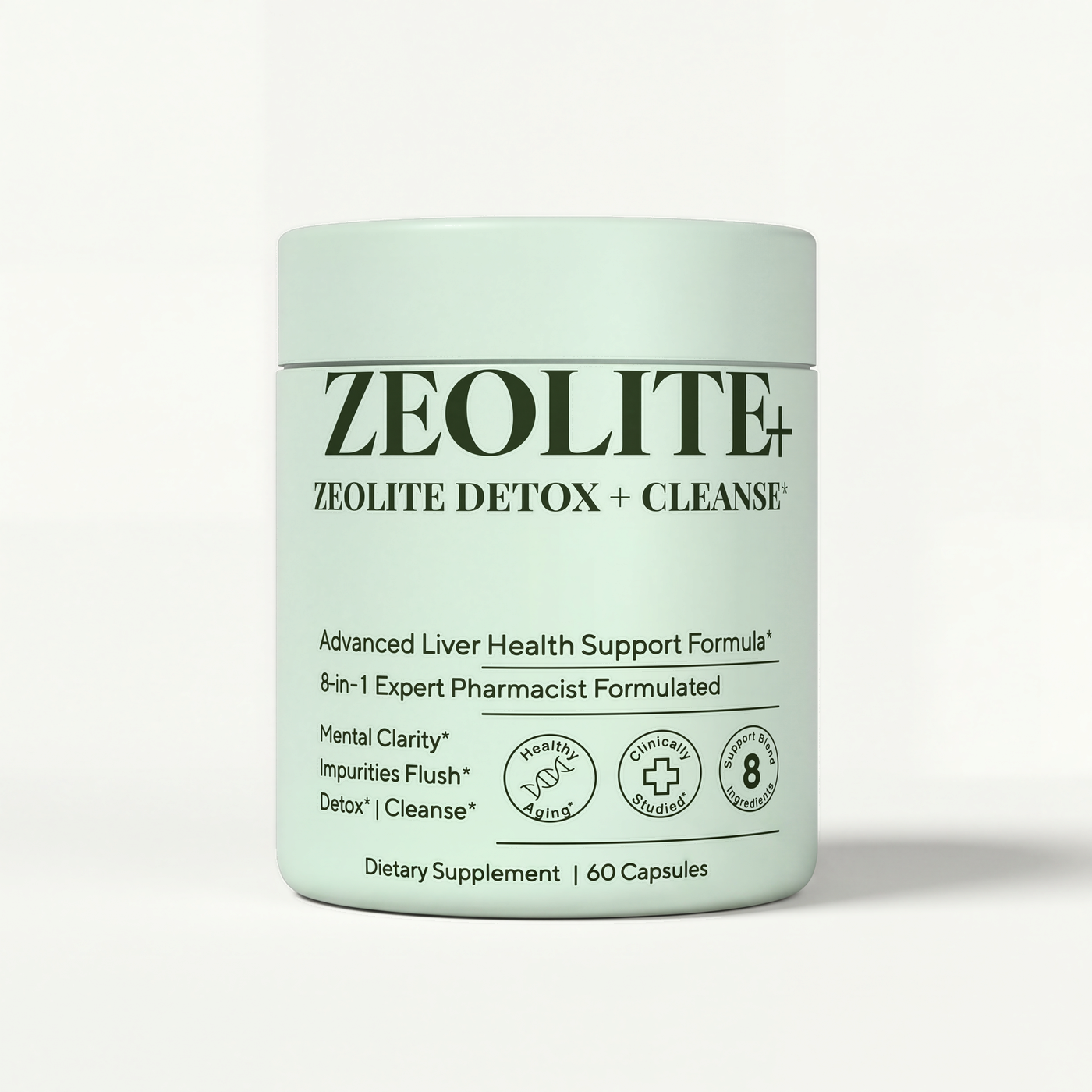
2. Zeolite Clinoptilolite
Zeolite clinoptilolite is a naturally occurring aluminosilicate mineral formed from volcanic ash that reacted with alkaline groundwater over millions of years. Its defining characteristic is a rigid, three-dimensional crystalline lattice with uniformly sized internal pores — approximately 0.4 nanometers in diameter.
Inside this lattice sit structural cations: calcium, magnesium, potassium, and sodium. These sit loosely in the lattice, held by electrostatic forces. When zeolite reaches the intestine and encounters heavy metal cations — lead (Pb²⁺), mercury (Hg²⁺), cadmium (Cd²⁺), arsenic in ionic form — those metals displace the structural cations because heavy metal ions have higher charge density and greater electrostatic affinity for the lattice binding sites. The heavy metal becomes physically trapped within the crystalline structure.
The zeolite, now containing the captured metal, continues through the intestine and is excreted in stool along with the bound metal. The structural cations that were displaced — calcium, magnesium — are released into the intestinal lumen and are available for absorption. This is sometimes described as an "exchange" because zeolite releases benign minerals while capturing toxic ones.
Zeolite is selective in a way activated charcoal is not. It specifically targets metal cations via this ion exchange mechanism. It doesn't adsorb organic compounds the way charcoal does. This makes it more targeted and potentially less disruptive to nutrient and medication absorption — though timing precautions are still warranted.
Research by Lamprecht et al. (2015), published in the Journal of the International Society of Sports Nutrition, found that supplementation with a micronized zeolite clinoptilolite preparation improved markers of gut barrier integrity in physically active subjects, reducing intestinal permeability markers including elevated zonulin. This suggests a secondary effect beyond ion exchange: possible support for tight junction function and gut wall integrity.
3. Chlorella and Spirulina
These freshwater algae have attracted research interest as food-based binders, primarily for mercury and cadmium. The proposed mechanisms involve binding to the algae's cell wall components. The evidence is less well-characterized than for activated charcoal or zeolite — most of the research is in animal models, and the binding capacity per gram is lower. They're worth including in a complete discussion of binders, with the honest caveat that they're lower-strength evidence than the first two categories.
4. Fiber-Based Binders (Psyllium, Pectin, Modified Citrus Pectin)
Fiber-based compounds don't bind toxins with the targeted chemistry that zeolite and charcoal do, but they contribute to excretion efficiency through a different mechanism. Gel-forming fibers like psyllium husk and pectin increase the viscosity of intestinal contents, which slows the movement of intestinal fluid across the gut wall — reducing the reabsorption window for compounds being excreted via bile.
Psyllium husk specifically has both soluble and insoluble fiber fractions. The soluble fraction forms a gel that traps bile acids and other compounds within the intestinal lumen, reducing their contact with absorptive surfaces. Modified citrus pectin has been studied specifically for heavy metal binding, with a small clinical trial showing reduced blood lead levels following supplementation.
These are best understood as clearance efficiency enhancers rather than primary binders — they improve the yield of the excretion process the body is already running.

The Enterohepatic Recirculation Context
Most people who take binders are thinking about what they're eating — intercepting metals or toxins from food before they're absorbed. This is a valid use case. But there's a second mechanism that's arguably more important for explaining why binders are useful even for people who eat relatively clean diets.
The liver is constantly processing compounds and excreting them into bile for fecal removal. This is Phase II detoxification at work. The bile — carrying metal-glutathione conjugates, processed toxins, and bile acids — is delivered to the small intestine through the bile duct.
In a well-designed system, these compounds would travel through the intestine and be excreted. But the small intestine, particularly the ileum, is highly efficient at reabsorbing compounds from bile. This is how the body recycles bile acids — an efficient physiological design that reduces the need to synthesize new bile acids from scratch. The problem is that some bile-excreted compounds, including certain heavy metal conjugates and mycotoxins, get caught in the same reabsorption process. They are absorbed back into the portal circulation, returned to the liver, and the cycle begins again.
This is enterohepatic recirculation — a feedback loop that can dramatically extend the time certain compounds stay in the body. Some toxins might otherwise have a biological half-life measured in days; enterohepatic recirculation can extend this to weeks or months.
Binders in the intestine intercept these bile-excreted compounds before they can be reabsorbed — breaking the recirculation loop. This is a meaningful contribution even in people with otherwise low exposure, because it improves the net yield of the liver's own export work. The liver is already doing the processing; binders help ensure the output reaches the stool rather than cycling back.
When to Use Binders — and When Not To
Binders are not a daily-indefinite supplement. Continuous use creates risk of mineral depletion and potential interference with nutrient absorption from food and supplements. They're tools for specific contexts.
Rational use cases:
During and after antibiotic courses. Antibiotics lyse bacteria, releasing bacterial cell wall debris including large amounts of LPS endotoxin into the gut lumen. Simultaneously, the gut barrier is compromised post-antibiotic. Binders during the post-antibiotic recovery window reduce the endotoxin burden hitting a permeable gut wall.
Higher-exposure dietary periods. If you're eating large predatory fish frequently, traveling to regions with water quality concerns, or otherwise going through a period of elevated exposure, a short binder cycle reduces the GI absorption of metals from that exposure.
Periodic cleanse protocols. A 2-4 week cycle, a few times per year, supports the liver's ongoing export work by improving the efficiency of bile-to-stool elimination.
SIBO treatment support. Small intestinal bacterial overgrowth produces significant endotoxin burden. Binders during SIBO treatment support symptom management while antimicrobials address the overgrowth.
When not to use binders:
With meals — binders will bind food nutrients with the same efficiency as toxins. Taken with a meal, activated charcoal will bind fat-soluble vitamins, minerals, and amino acids. This is how you turn a nutrient-dense meal into a reduced-nutrition event.
Alongside medications — this is the most important safety rule. Activated charcoal is used in overdose scenarios specifically because it binds drugs. If you take activated charcoal within a few hours of any oral medication, you are reducing that medication's absorption. This applies to everything: thyroid medication, antidepressants, hormonal contraceptives, blood pressure medication, antibiotics. The rule is absolute: 2+ hours separation minimum.
Indefinitely — cycling off allows full nutrient absorption and prevents the mineral depletion risk that comes from continuous binder use.
The Separation Requirement: Non-Negotiable
The mandatory timing rules for binders are worth stating once more, clearly:
Activated charcoal: - 2+ hours from any pharmaceutical medication - 1+ hour from meals - 1+ hour from other supplements
Zeolite clinoptilolite: - Apply the same precautionary timing as activated charcoal - The ion exchange mechanism is more selective, but taking precautions is rational
Natural windows that work: First thing in the morning before breakfast. Mid-afternoon, at least 2 hours after lunch and 1 hour before dinner. Before bed, at least 1-2 hours after dinner and all evening supplements.
This is not excessive caution — it's the mechanism. The same chemistry that makes binders effective makes them indiscriminate binders when taken incorrectly. Plan the timing and the rest takes care of itself.
Frequently Asked Questions
Are binders safe to take daily? Short-term daily use during a defined protocol window (2-4 weeks) is the standard approach and is generally well-tolerated. Long-term, indefinite daily use is not recommended because of the risk of cumulative mineral depletion and interference with fat-soluble vitamin absorption. Cycling is the appropriate model: use for a defined period, then take a break before repeating if needed.
What do binders actually bind? Activated charcoal binds a broad spectrum of organic compounds via adsorption: bacterial toxins, mycotoxins (mold-derived toxins), pharmaceutical drugs, bile acids, and some metal complexes. Zeolite clinoptilolite binds heavy metal cations specifically via ion exchange: lead, mercury, cadmium, and arsenic in ionic form. Both intercept compounds in the GI lumen — they do not bind substances already in the bloodstream or tissue.
Can binders remove heavy metals? Binders can intercept heavy metals in the GI tract before they're absorbed (from food and water) and can intercept metals the liver is excreting into bile before they're reabsorbed (enterohepatic recirculation). They cannot bind or remove metals that have already been absorbed and distributed to tissue — that requires systemic chelation, a medical procedure. The distinction matters.
What is the difference between activated charcoal and zeolite? Mechanism: activated charcoal uses van der Waals adsorption (non-specific, high-capacity, broad-spectrum). Zeolite clinoptilolite uses ion exchange (selective for metal cations, releases benign minerals). Selectivity: zeolite is more targeted; charcoal is broader. Together they're complementary — zeolite catches metal cations that charcoal doesn't target well; charcoal catches organic toxins that zeolite doesn't address.
When should you take binders? Away from everything else. The natural windows: 30-60 minutes before eating in the morning (before breakfast), between meals with a full glass of water, or at night well after dinner and after all evening supplements are cleared. Never with medications. Plan the timing around your medication schedule first, then fit binders in around it.
Do binders interfere with medications? Activated charcoal can and does interfere with oral medication absorption — this is the clinical mechanism behind its use in drug overdose treatment. The same binding chemistry that neutralizes an overdosed drug will reduce normal medication absorption if taken too close together. This is not a theoretical concern. Minimum 2 hours separation from any oral medication. If you take medications and are considering binders, verify the timing with your pharmacist or prescribing physician to ensure no interaction risk.