The Mechanism Nobody Talks About
Rigorous clinical trials led by Dr. Gonzales and colleagues at Cayetano Heredia University in Peru tested the assumption directly. They gave men maca for extended periods and measured testosterone, LH (the hormone that stimulates testosterone production), FSH, estrogen, and other hormonal markers at regular intervals.
The result: no significant changes in any hormone measured. Testosterone didn't rise. LH didn't change. Estrogen was unchanged.
But libido improved significantly — in a randomized, double-blind, placebo-controlled design. Sexual desire increased, measured by validated instruments, independently of any hormonal change.
This finding confused the supplement industry, which had been marketing maca as a testosterone booster for years. But it pointed toward a more interesting biology.
Subsequent research identified the actual mechanism: the endocannabinoid system (ECS), specifically through inhibition of fatty acid amide hydrolase (FAAH).
FAAH is the enzyme that degrades anandamide — often called the "bliss molecule," your body's primary endocannabinoid. Anandamide is involved in mood, motivation, pain modulation, and centrally, in sexual desire and pleasure. When FAAH is inhibited, anandamide degrades more slowly, accumulating to higher levels. The result is an enhancement of the endocannabinoid tone that governs the neurological drive we experience as libido.
This is not a testosterone mechanism. It's a central nervous system and neuroendocrine mechanism — and it's why maca can improve libido in both men and women, in pre- and post-menopausal women, in subjects with normal and low testosterone alike. It's not working on the hormonal source of sexual drive. It's working on the neurological experience of it.
Why Black Maca Specifically
There are three varieties of maca: yellow (the most common), red, and black. They have distinct phytochemical profiles and distinct effects.
Black maca is the rarest and most potent variety, comprising only 15% of the Andean harvest. Research has documented that black maca specifically produces the strongest effects on sperm production and motility — a consistent finding across multiple animal and human studies that doesn't extend equally to yellow or red maca.
In human studies, black maca supplementation has shown: - Significant improvements in sperm concentration - Improved sperm motility - Enhanced energy and endurance compared to yellow maca controls
The male fertility angle is one of the most clinically consistent findings in maca research — and it's variety-specific. A maca supplement using primarily yellow maca (cheaper, more available) cannot claim equivalence to the black maca evidence base.
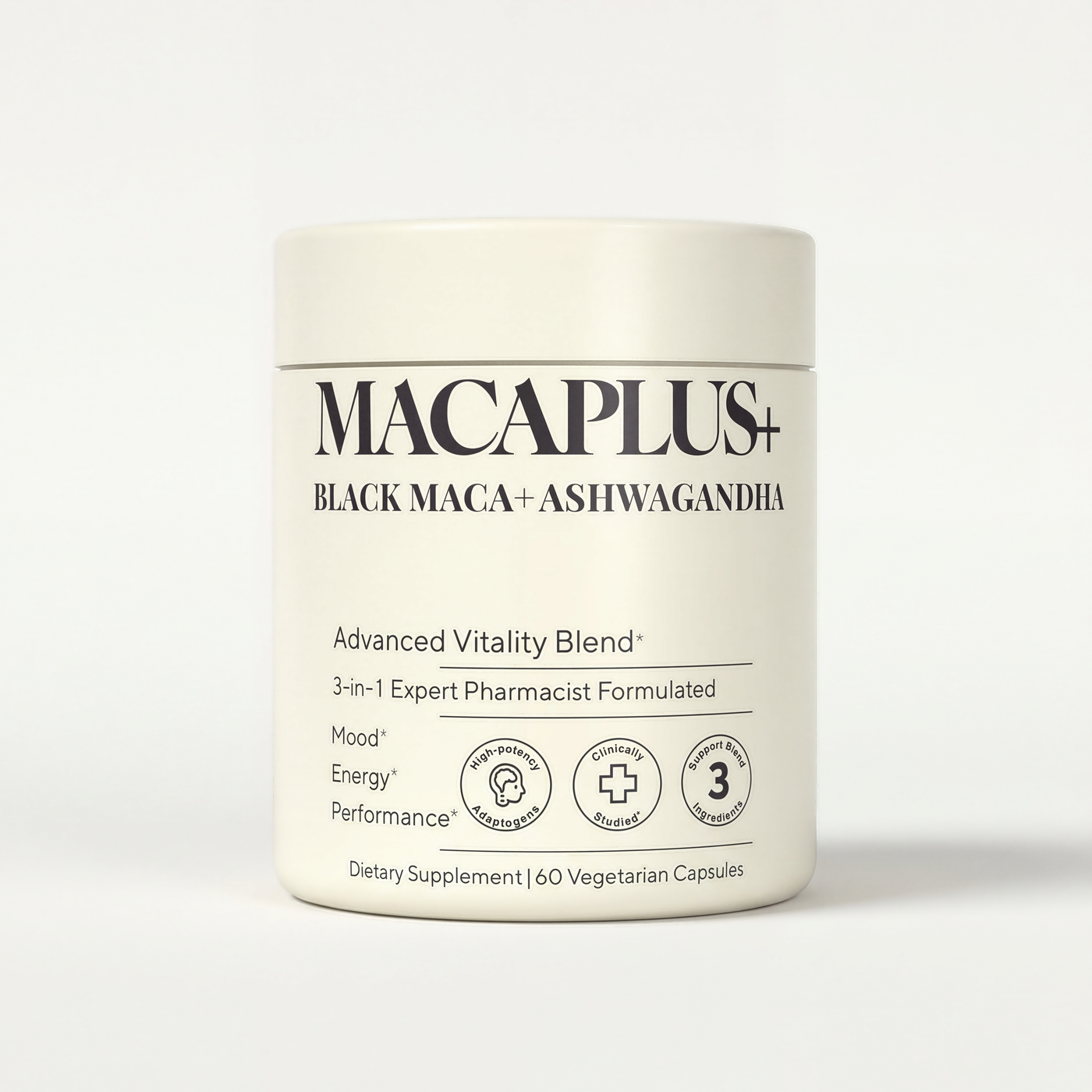
The Plus+Ultra Maca formula uses black maca at a 40:1 concentration ratio — a genuine concentration that delivers equivalent phytochemical density to 40g of raw black maca root per dose.

The Ashwagandha Advantage
Most maca products contain only maca. The Plus+Ultra formula pairs black maca with 400mg of ashwagandha standardized to 10% withanolides — and the distinction matters.
Withanolides are the primary bioactive compounds in ashwagandha — steroidal lactones that drive the herb's adaptogenic, testosterone-supporting, and anti-stress effects. Different ashwagandha extracts vary enormously in withanolide content. The industry standard, KSM-66, is one of the most-studied extracts available — standardized to 5% withanolides, typically delivered at 300–600mg, yielding 15–30mg of withanolides per dose.
The ashwagandha in the Plus+Ultra Maca formula is standardized to 10% withanolides, at 400mg — delivering 40mg of withanolides per serving. That's significantly more than KSM-66 at its most common dosing, in a formula already built around black maca's libido and fertility mechanism.
Why does this matter for a maca product?
Because the two adaptogens address different parts of the same system:
Maca (via FAAH inhibition/ECS): Works on neurological sexual drive, sperm health, and energy — a system that functions independently of hormonal status.
Ashwagandha (via withanolides/HPA axis): Works on the hormonal and stress dimension — reducing cortisol, supporting testosterone biosynthesis, lowering the HPA axis hyperactivation that chronic stress creates and that directly suppresses healthy sexual function.
Elevated cortisol is one of the most common drivers of reduced libido — not hormonal deficiency, but stress-axis suppression of the entire reproductive system. Ashwagandha's cortisol-reducing effects remove that suppressive pressure. Maca's ECS effects then work in a less inhibited system.
The combination doesn't just add two ingredients together. It addresses the problem from complementary directions.
Fenugreek: The Supporting Saponin Layer
The formula also includes 100mg of fenugreek standardized to 50% saponins — yielding 50mg of furostanolic saponins per serving. Fenugreek saponins have been shown in several randomized trials to support free testosterone levels by inhibiting aromatase (the enzyme that converts testosterone to estrogen) and 5-alpha reductase activity. At 50mg of active saponins, this is a meaningful dose.
The fenugreek layer adds a hormonal dimension to complement maca's non-hormonal ECS mechanism and ashwagandha's stress-reduction effects — creating a formula that touches the libido and vitality system at three distinct biological levels.
What the Research Shows About Libido Specifically
The randomized controlled trial published in Andrologia by Gonzales et al. randomized men with mild erectile dysfunction to placebo or maca extract for 12 weeks. The finding: significant improvements in sexual function and overall sense of wellbeing independently of testosterone change.
A separate study in postmenopausal women — the population often hardest to impact with testosterone-focused supplements — found that maca significantly reduced sexual dysfunction scores and improved overall wellbeing. The estrogen-independent mechanism explains why: postmenopausal women have low estrogen and low testosterone relative to premenopausal baseline, but their endocannabinoid system remains fully functional and responsive to FAAH inhibition.
What to Expect
Maca's timeline tends to be moderate — faster than hormonal interventions, slower than stimulants:
- Weeks 1–3: The ECS mechanism can begin producing subjective changes in mood, energy, and motivation relatively early. Some users report this within the first two weeks.
- Weeks 3–6: Improvements in sexual desire and energy — the most consistent reported outcomes — tend to clarify and stabilize in this window.
- Months 1–3: For men focused on sperm health markers, the clinical evidence uses this timeline. Sperm production is a roughly 74-day cycle; consistent supplementation over 2–3 months is what the research supports.
The most important context: maca and ashwagandha are adaptogens — they work with the body's existing regulatory systems, not against them. The more stress, sleep deprivation, or HPA axis dysregulation is present, the more pronounced the response is likely to be as those factors are addressed.
Who This Is For
Anyone focused on libido, vitality, fertility support, and the stress-sex drive connection that's rarely discussed honestly in supplement marketing. The Plus+Ultra Maca formula is particularly relevant for:
- Men focused on fertility and sperm health
- Couples actively trying to conceive who want to address male fertility factors comprehensively
- Anyone experiencing stress-suppressed libido and wanting to address both the stress axis and the ECS simultaneously
- Women (pre- or post-menopausal) interested in libido and energy support — maca's ECS mechanism is not sex-specific