The SHBG Problem Nobody Talks About
When most people think about testosterone, they think about total testosterone — the number that shows up on a blood test. But total testosterone is not the testosterone your body uses. Most of it is bound to proteins: about 60–70% to sex hormone-binding globulin (SHBG) and 30–40% to albumin. Only 1–3% is "free" — unbound, biologically active, and able to bind to androgen receptors in muscle, brain, bone, and every other tissue where testosterone's effects actually occur.
This distinction matters enormously as men age.
Total testosterone declines roughly 1–2% per year from the early thirties onward. But SHBG levels increase with age. Which means free testosterone — the fraction doing the actual work — falls faster than total testosterone. Many men in their forties and fifties have total testosterone levels technically within the "normal" range while experiencing significant free testosterone deficiency that doesn't show up on standard testing.
The symptoms: declining muscle mass and recovery, reduced energy, flattened motivation, decreased libido. The feeling that something has changed, but bloodwork says everything is fine.
Tongkat Ali's primary mechanism addresses this directly — not by stimulating testosterone production from scratch, but by modulating SHBG's binding activity, releasing more of the total testosterone pool into its free, bioavailable form.

What the Clinical Evidence Shows
The clinical research on Tongkat Ali has been accumulating since the late 1990s, with a major meta-analysis published in Phytotherapy Research in 2021 pooling data across all randomized controlled trials. The findings:
Tongkat Ali supplementation produced a statistically significant increase in serum testosterone (standardized mean difference = 1.352 — a large effect size in clinical research terms). The trials included healthy middle-aged adults, aging men with partial androgen deficiency (PADAM), and recreationally active individuals. The effects were consistent across populations: increased total and free testosterone, decreased SHBG in several studies, and associated improvements in sexual function, muscle strength, and lean body mass.
The specific extract studied in most trials — Physta, a standardized water-soluble extract of Eurycoma longifolia — was used at 200mg in the most-cited trials. It's one of the most-researched botanical extracts in men's health.
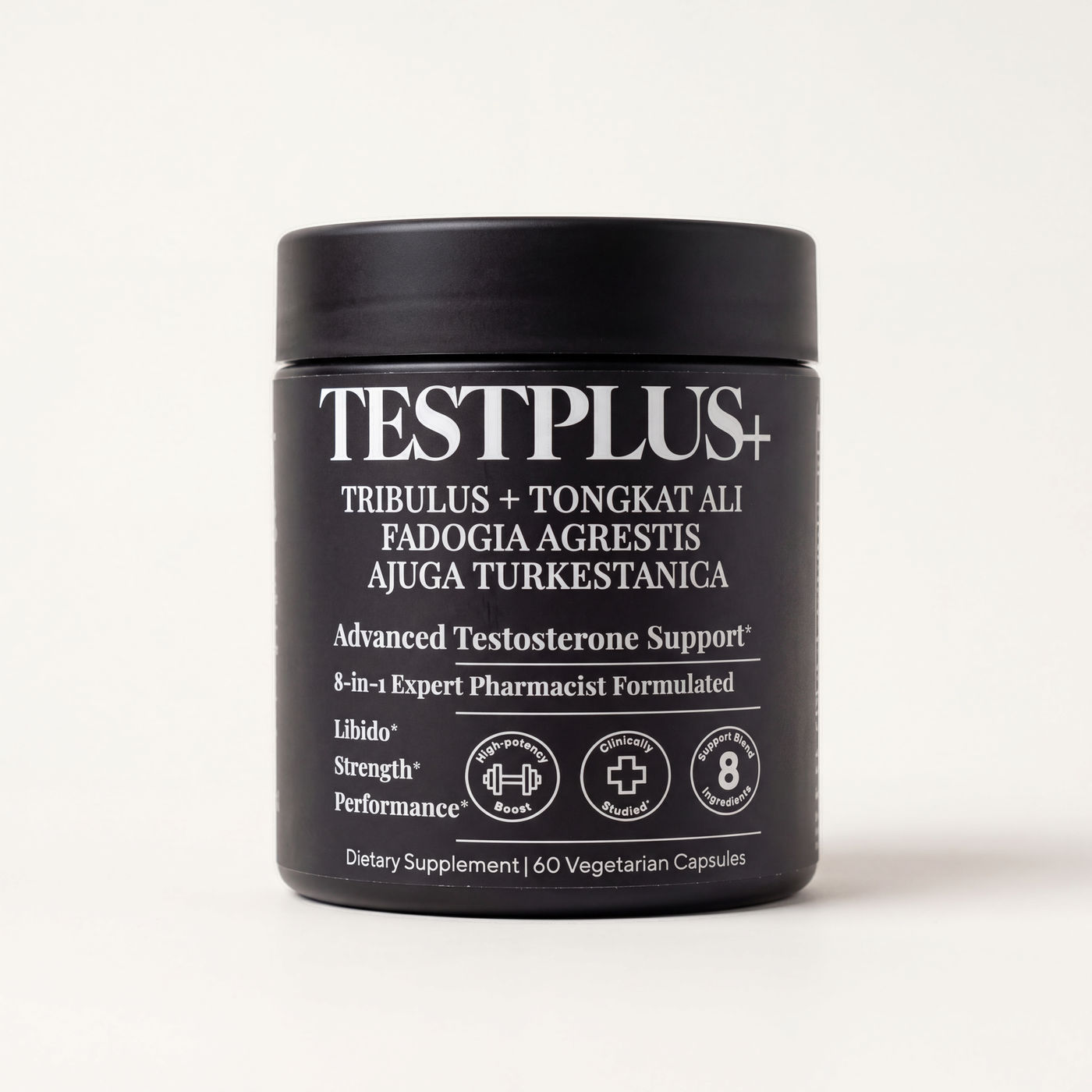
TESTPLUS contains 700mg.
Why the Higher Dose
Three and a half times the most-studied dose is a deliberate formulation decision, not excess.
The 200mg dose in the landmark trials was the dose that produced consistent, measurable effects. It was not established as the ceiling for benefit — it was the dose researchers chose for their initial trials, which then became the standard because that's how supplement science works.
More recent dose-ranging data and observational evidence from cultures where Tongkat Ali has been consumed as a traditional food and tonic — where concentrations far exceed what early pharmaceutical-style trials used — consistently suggest that higher doses are well-tolerated and associated with more pronounced effects on vitality, energy, and male hormonal health.
The 700mg dose in TESTPLUS positions the product at the upper end of what clinical evidence supports, informed by both the clinical literature and the traditional use context. It's also the dose needed to make the formula's Tongkat Ali contribution clearly differentiated in a market where most products deliver 200mg and claim clinical backing for a dose they're actually five-fold below.
The Supporting Cast
Shilajit (Mentioned for Stack Context)
Shilajit — the Himalayan mineral resin covered in depth in its own article — complements Tongkat Ali's SHBG mechanism from a different direction, through fulvic acid's effects on mitochondrial function and testosterone biosynthesis enzymes. The two ingredients work on different parts of the testosterone production and availability pathway.
Ashwagandha (50mg)
One of the most extensively studied adaptogens in Ayurvedic medicine, with a particularly strong evidence base for stress, cortisol reduction, and male hormonal health. Elevated cortisol actively suppresses the HPG axis (the hypothalamic-pituitary-gonadal axis that regulates testosterone production) — which is why chronic stress and low testosterone are so commonly paired. Ashwagandha's cortisol-lowering effects create the hormonal environment in which testosterone can be optimally expressed.
At 50mg, this is a supporting dose rather than a full therapeutic dose — its role in TESTPLUS is to provide cortisol and HPG axis support alongside the formula's primary testosterone-focused ingredients.
Panax Ginseng (50mg)
Korean Red Ginseng has clinical evidence for sexual function support, nitric oxide pathway activation, and energy. At 50mg, it's a supporting botanical — contributing to the formula's vitality and performance profile without being the primary driver.
Ginkgo Biloba (50mg)
Supports circulation and is included for its vasodilatory and cognitive clarity effects that pair with the vitality focus of the overall formula.
Tribulus Terrestris (50mg)
Traditional botanical included in men's health formulas for its supporting role in overall vitality. Clinical evidence for direct testosterone effects is mixed and inconsistent at this dose — its value in TESTPLUS is as a supporting botanical within a formula whose primary testosterone support is driven by Tongkat Ali.
Maca Root (50mg)
Covered in depth in the Maca article — operates via the endocannabinoid system rather than direct hormonal pathways, supporting libido and sexual function through a distinct mechanism from Tongkat Ali's SHBG pathway. The combination covers hormonal availability (Tongkat Ali) and neurological drive (Maca) simultaneously.
The Honest Science on Fadogia Agrestis
TESTPLUS also contains Fadogia Agrestis (300mg). In the interest of accuracy, this ingredient deserves direct acknowledgment.
Fadogia Agrestis is a West African shrub that gained attention in supplement circles after early animal studies suggested it might stimulate luteinizing hormone (LH) and testosterone production through gonadotropin-like activity. It has been widely popularized in online wellness communities.
The clinical reality: as of publication, there are no published randomized controlled trials in humans demonstrating testosterone effects for Fadogia Agrestis. The evidence base consists of rodent studies — which establish biological plausibility but cannot be extrapolated to human dosing or human safety without human trial data. Some rodent research has raised questions about hepatotoxic effects at high doses, though these have not been studied in humans.
Why include it? Because TESTPLUS is built for customers who are familiar with the botanical testosterone support category and specifically request formulas that include novel, emerging, and traditionally-used botanical compounds alongside the evidence-backed core. Fadogia represents the exploratory layer of the formula — the ingredient for people who want comprehensive botanical coverage and understand the current evidence landscape.
The formula's clinical backbone is Tongkat Ali. Fadogia is the frontier.
What to Expect
Tongkat Ali's effects emerge progressively as SHBG binding is modulated and the free testosterone pool shifts. The timeline from clinical trials:
- Weeks 1–2: Energy and stress resilience are often the earliest reported effects — likely related to Ashwagandha's cortisol effects and the overall adaptogenic load of the formula.
- Weeks 3–5: Physical performance and recovery changes begin to emerge for men who train consistently. The hormonal environment shifts before the body composition changes do.
- Months 1–3: This is the window where most clinical trials measure their primary outcomes. Libido, lean mass retention, and morning vitality are the most consistent subjective markers.
The most important variable: lifestyle environment. Testosterone support supplements work within the context of sleep quality, resistance training, stress management, and body composition. A formula built around the best-researched botanical in men's health still performs in the context of the biology it's supporting — not despite it.
Who This Is For
Men 30+ who are actively managing their hormonal health, physical performance, and vitality — and want a formula with a meaningful Tongkat Ali dose, not the minimum required to print it on a label.
Pairs best with: Shilajit — for the fulvic acid and testosterone biosynthesis angle — and MAGPLUS — for the sleep quality that testosterone production absolutely depends on.